



“Data-driven culture” is often a myth. Organizations collect data, but lack decision ownership, clarity, and action, resulting in data-rich yet decision-poor environments.
Over the last decade, the word “data-driven culture” has become one of the most repeated phrases in corporate strategy conversations.
It appears in annual reports, transformation roadmaps, board presentations as well as hiring mandates. Organizations proudly announce investments in analytics platforms, AI initiatives, dashboards and data lakes, all in the name of becoming more data-driven.
Yet after working closely with leadership teams across finance, growth, operations and strategy, I’ve come to a difficult realization: Most organizations are not struggling with a lack of data. They are struggling with a lack of decision discipline.
This distinction matters more than we admit.
The problem is not that companies don’t believe in data. The problem is that many assume that installing systems and hiring analysts automatically changes how decisions are made. It doesn’t. Culture is not installed through software. It is shaped through behavior.
Let’s unpack this honestly.
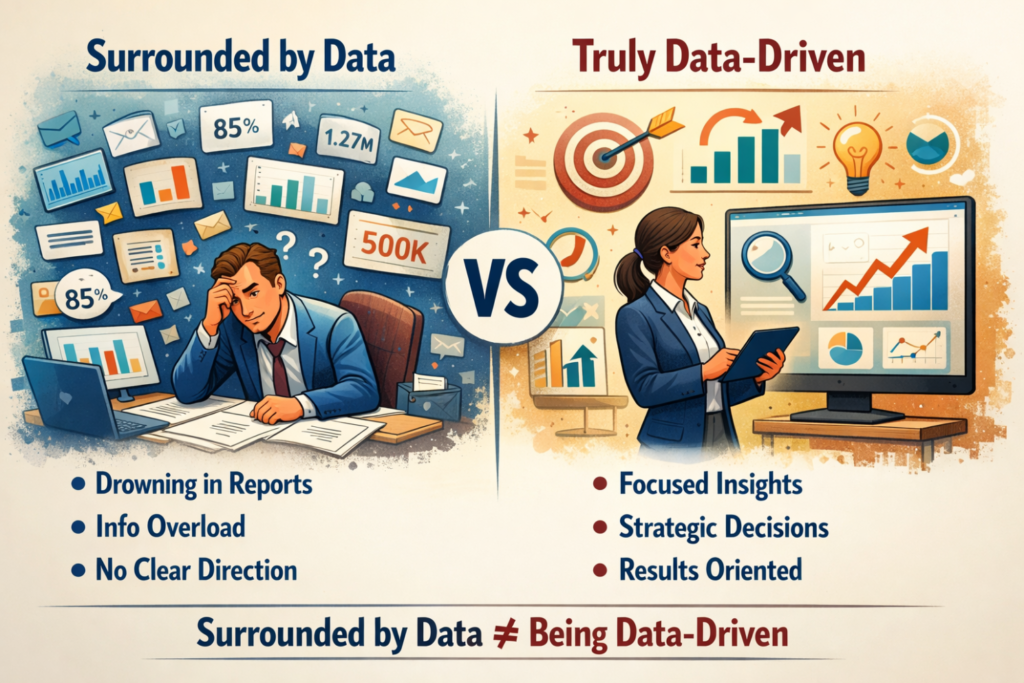
What Organizations Believe They Are Building
When leadership teams say they are building a data-driven culture, they usually point to tangible progress:
- They have dashboards that update in real time.
- They have centralized data warehouses.
- They have automated reports replacing manual Excel work.
- They are experimenting with predictive models.
- They have defined KPIs across departments.
All of these are important steps. I strongly advocate for them.
But I’ve also observed that these investments often create a sense of maturity that may not actually exist. The presence of infrastructure creates the illusion of transformation. The dashboards are live. The analytics team is in place. Reports are faster than ever.
And yet, when you sit inside critical decision meetings, something interesting happens.
The numbers are presented. Everyone nods. Then the final call is influenced by hierarchy, urgency or instinct.
Data is acknowledged, but it does not always shape the direction.
That gap, between access to data and willingness to let it influence decisions is where the myth lives.

The Subtle Ways the Myth Plays Out
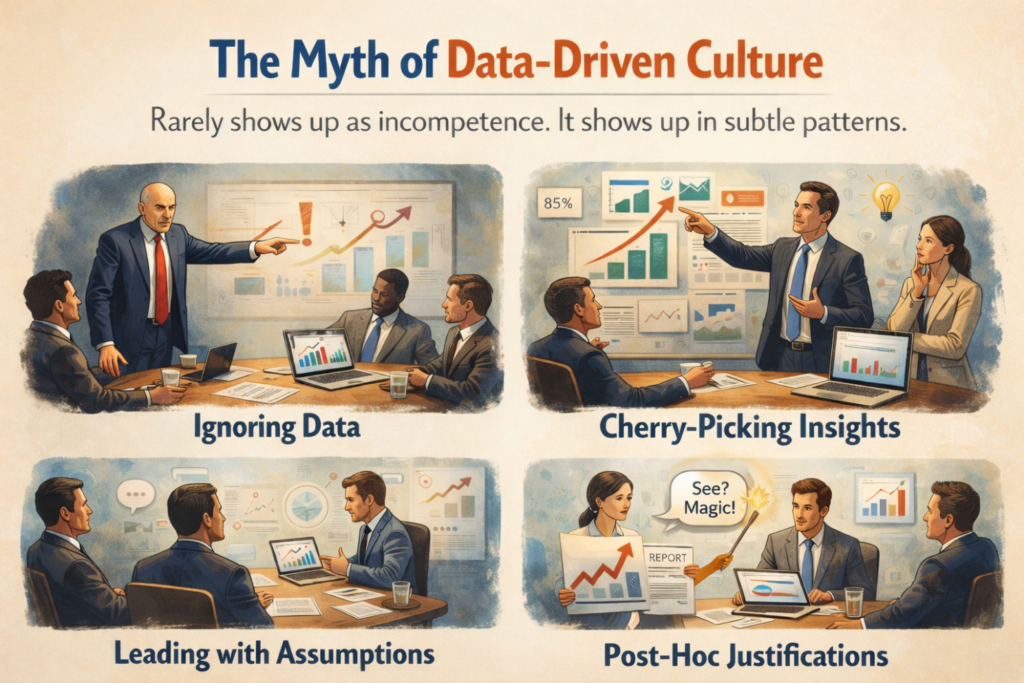
The myth of data-driven culture rarely shows up as incompetence. It shows up in subtle patterns.
Data Is Used to Support Decisions, Not Shape Them
In many cases, decisions are formed based on experience or strategic preference. Only afterward does someone ask the analytics team to validate the direction.
Instead of asking, “What is the data suggesting we should do?” the question becomes, “Can we pull data to justify this?”
The shift may seem minor, but it changes the role of analytics from being a compass to being a presentation layer.
True data-driven environments reverse that order. They allow evidence to inform direction before consensus forms.
KPIs Are Monitored but Not Designed for Action
Most organizations track performance metrics diligently. Monthly dashboards are reviewed. Variances are discussed. Targets are compared against actuals.
But a crucial question is often missing: What happens when this metric moves?
If customer churn increases by 2%, who is responsible for responding? If acquisition cost spikes beyond a threshold, what is the predefined action? If inventory turnover slows, what operational decision gets triggered?
Without clearly defined response mechanisms, KPIs become observational tools rather than operational triggers. They tell us what happened, but they don’t tell us what to do next.
A metric without ownership is just a number on a screen.
Leadership Conversations Are Backward-Looking
Another pattern I frequently see is the dominance of retrospective analysis. Leadership meetings focus heavily on last month’s performance: revenue variances, cost overruns, missed targets.
While historical review is necessary, it is not sufficient.
Very few conversations begin with structured hypotheses.
Rarely do teams ask: What are we testing this quarter? Which assumptions are we validating? Where could we be wrong?
A data-driven culture is not just about reporting outcomes. It is about systematically challenging assumptions before they become expensive mistakes.
The Real Barrier Is Not Technology. It Is Accountability
The deeper reason many organizations stop short of becoming truly data-driven is not a skills gap. It is discomfort.
A genuinely data-driven culture introduces a level of transparency that can feel threatening. When forecasts are documented and later compared against actual results, assumptions become measurable. When KPIs are linked to named decision owners, accountability becomes visible.
This level of clarity leaves less room for ambiguity.
Data exposes weak assumptions. It surfaces underperformance. It highlights flawed strategies earlier than many leaders would prefer.
It is far easier to say, “The market shifted unexpectedly,” than to review a documented forecast and admit that an assumption was flawed.
That is why many companies invest heavily in analytics infrastructure but hesitate to institutionalize decision reviews. Dashboards are safe. Behavioral change is harder.
What a Genuine Data-Driven Culture Actually Looks Like
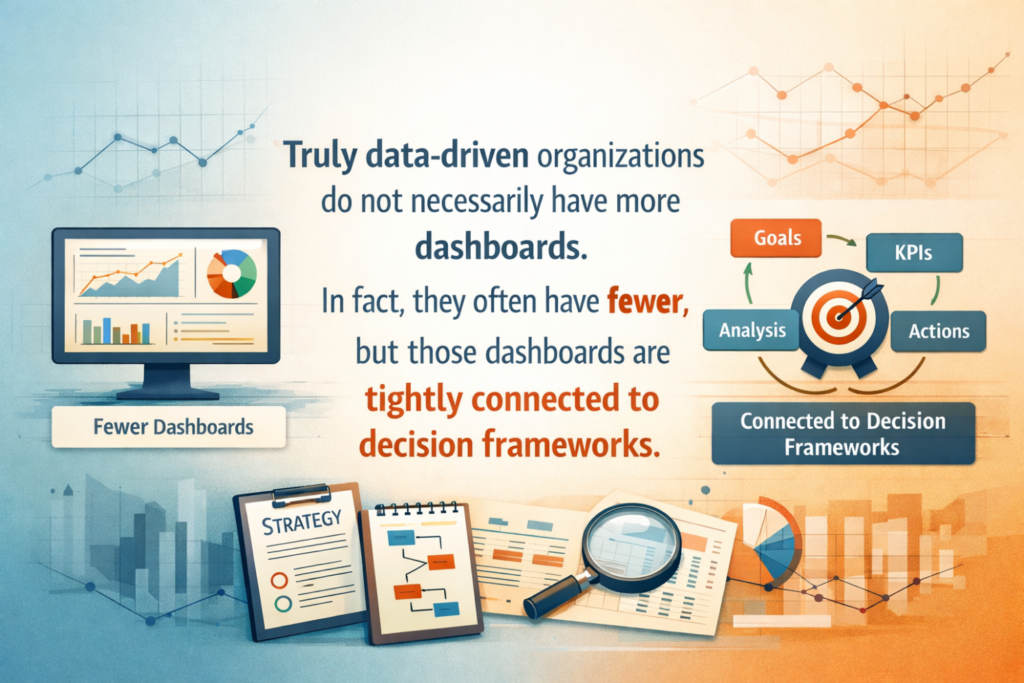
In my experience, truly data-driven organizations do not necessarily have more dashboards. In fact, they often have fewer but those dashboards are tightly connected to decision frameworks.
In such organizations:
- Decisions are preceded by clearly articulated assumptions.
- KPIs are tied to named owners with predefined action thresholds.
- Forecasts are reviewed against outcomes on a regular cadence.
- Experiments are run deliberately, not accidentally.
- Learning is captured and reused, not forgotten.
What stands out most is not the sophistication of their tools, but the consistency of their discipline.
- Evidence can challenge seniority.
- Performance reviews include forecast accuracy, not just results.
- Strategic pivots are triggered by leading indicators, not by panic.
These behaviors create culture. Not software.
Moving Beyond the Phrase “Data-Driven”
I increasingly believe that the phrase itself may be part of the problem. “Data-driven” suggests that data alone leads the organization. In reality, data informs but people decide.
What organizations truly need is a decision-driven culture powered by data.
A decision-driven culture asks:
- How are decisions structured?
- How are assumptions recorded?
- How are outcomes evaluated?
- How is learning institutionalized?
When decision architecture is weak, even the most advanced analytics stack cannot create impact. Conversely, when decision processes are disciplined, even relatively simple analytics can generate significant value.
The Real Competitive Advantage
Organizations do not gain advantage from having more data than competitors. In most industries today, data availability is not the bottleneck.
Advantage comes from how quickly and objectively an organization can translate information into disciplined action.
It comes from:
- Reviewing forecasts honestly.
- Correcting assumptions early.
- Running structured experiments.
- Making accountability explicit.
Data does not transform organizations. Decision discipline does.
When evidence can challenge hierarchy, when assumptions are written before execution, and when learning is systematic rather than accidental, that is when culture truly shifts.
Until then, “data-driven culture” remains a comforting label.
The real work begins when leadership chooses to design decision systems that are transparent, measurable and continuously improving.
That is not a technology initiative. It is a leadership commitment.
Leave a Reply