



If more data is making your people hesitate instead of decide, don’t expect better decisions, expect data-driven anxiety.
Over the last few years, I have been working closely with leadership teams across industries — BFSI, Pharma & Life Sciences, Manufacturing, Retail etc.
There is one observation that keeps repeating.
We have more data than ever before. But we also have more confusion, hesitation and pressure around decisions than ever before.
This is not a technology problem. This is a behavioral and organizational problem.
I call this data anxiety.
What Is Data Anxiety?
Data anxiety is not about lack of data. It is the opposite.
It is the stress and hesitation that comes from having too much data, too many interpretations and too much visibility and without clear decision ownership.
It shows up in subtle ways:
- Teams asking for “one more cut of data” before deciding
- Leaders delaying calls because “let’s validate this once more”
- Meetings ending without closure, but with more analysis tasks
I remember a review with a consumer business where we were discussing a pricing change.
All the data was available:
- historical pricing
- competitor benchmarks
- demand trends
Still, the decision was pushed by two weeks.
Not because the answer was unclear, but because nobody felt comfortable committing.
That discomfort is data anxiety.
How Does Data Anxiety Actually Occur?
From what I have seen, data anxiety does not come from data itself. It comes from how organizations structure decisions around data.
There are four common triggers.
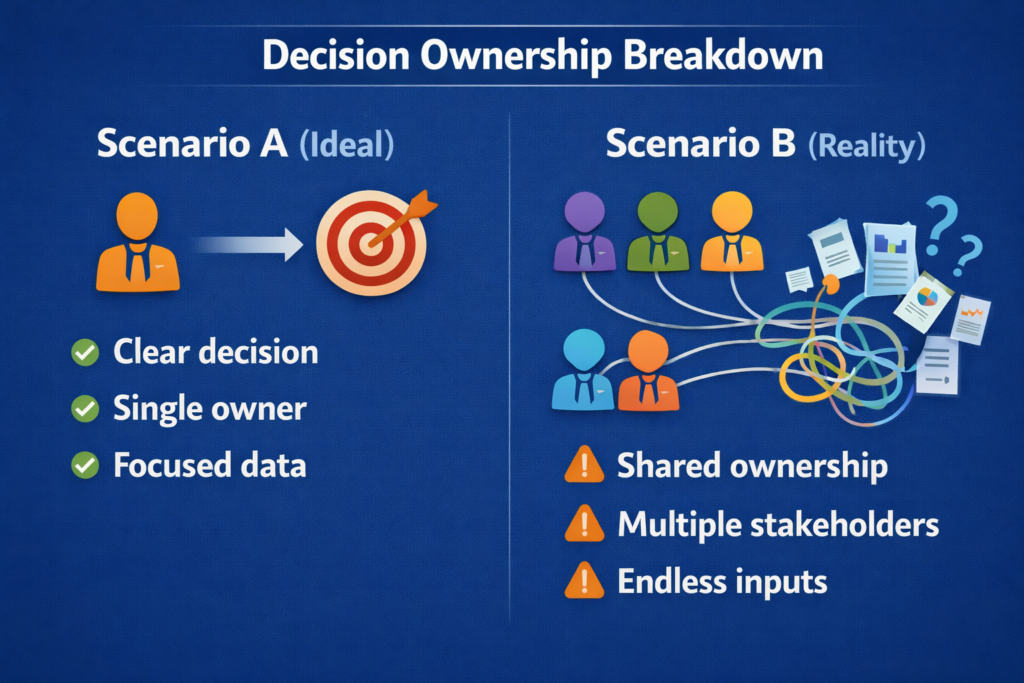
1. No Clear Decision Ownership
When data is available to everyone, but decision rights are unclear, hesitation increases.
In one manufacturing client, the same production decision involved:
- sales team
- operations team
- finance team
Everyone had data. No one had final ownership.
So the discussion kept moving, but the decision did not.
More data + unclear ownership = delayed decisions
2. Multiple Versions of Interpretation
Data rarely speaks on its own. It needs interpretation.
And interpretation varies.
I have seen the same sales report being explained in three different ways:
- “temporary dip”
- “structural decline”
- “seasonal variation”
All backed by data.
When this happens, the problem is not data quality. It is interpretation conflict.
And that creates hesitation.
3. Excessive Visibility
With dashboards and real-time reporting, everything is visible.
At first, this feels like control.
But over time, it creates pressure.
In an e-commerce setup, hourly sales dips triggered immediate reactions e.g. campaign changes, pricing tweaks, escalation calls.
By the end of the day, sales normalized.
The reaction was unnecessary.
This is what I call the visibility trap. When you start reacting to every signal, even when it is just noise.
4. Fear of Being Proven Wrong
This is the most important and least discussed factor.
Earlier, decisions were made with limited data and there was some tolerance for error.
Now, with data available:
- decisions are recorded
- assumptions are traceable
- outcomes are measurable
So people become cautious.
Not because they don’t know what to do. But because they are worried about being questioned later.
This shifts behavior from: decision-making → decision-defending
And that is where anxiety builds up.
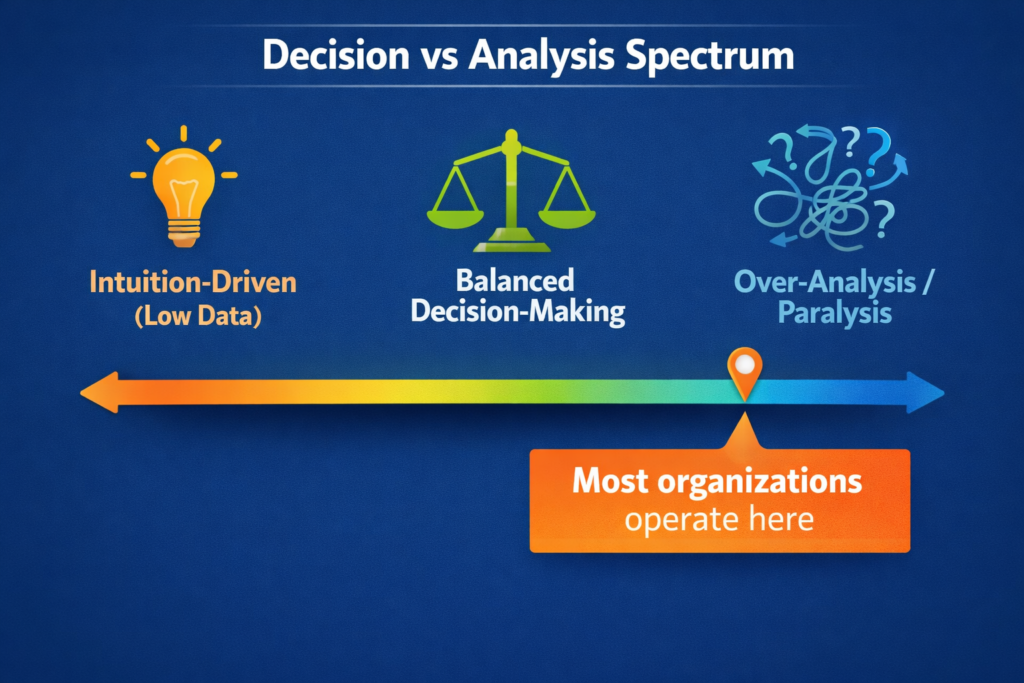
How Data Anxiety Impacts Decision-Making
This is where it becomes serious.
Data anxiety is not just a feeling. It has real business impact.
1. Monetary Impact (Direct Business Loss)
I have seen multiple instances where delayed decisions led to actual financial impact.
- A retail client delayed discounting decisions waiting for deeper analysis → missed seasonal sales window
- A manufacturing firm delayed production ramp-up → lost demand opportunity
- A SaaS company slowed feature releases due to over-analysis → lower user engagement growth
In all these cases, the issue was not wrong decisions. It was late decisions.
And in business, timing is money.
2. Non-Monetary Impact (Organizational Health)
The bigger damage is often invisible.
Over time, data anxiety leads to:
- decision fatigue (too many inputs, no closure)
- reduced ownership (people avoid taking calls)
- over-dependence on consensus
- loss of speed and momentum
I have seen teams where:
- every decision needs alignment
- no one wants to take the first call
- meetings increase, but outcomes reduce
This creates a culture where:
“We are always busy analyzing, but rarely decisive.”
Why More Data Is Not Solving This Problem
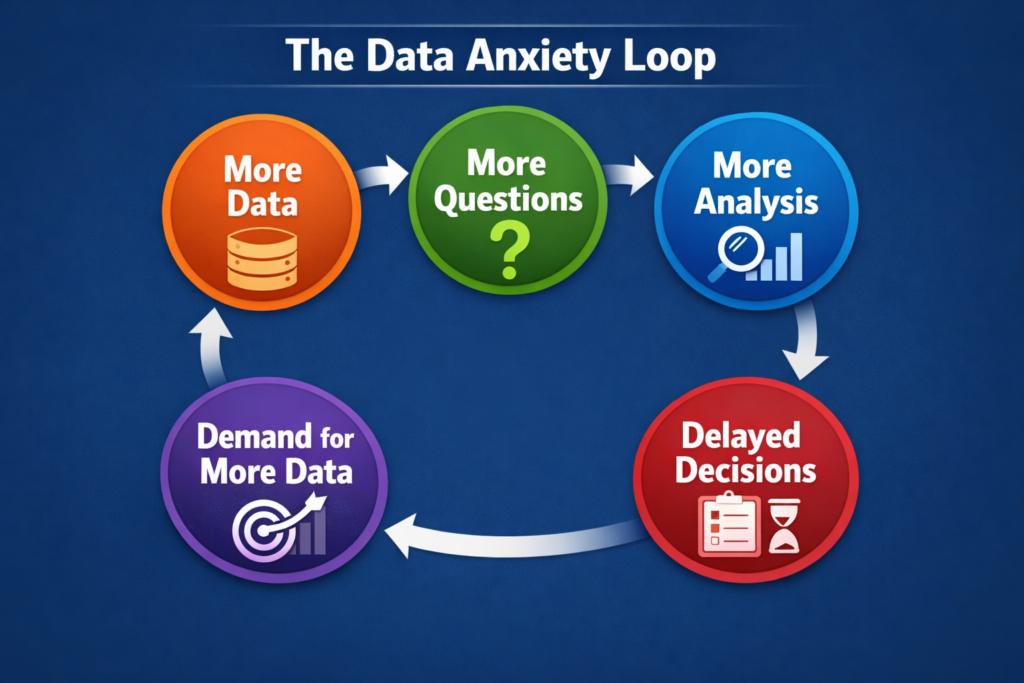
The natural reaction to confusion is to ask for more data.
But that usually makes things worse.
Because:
- more data → more interpretations
- more interpretations → more discussions
- more discussions → more delay
At one client, adding a new dashboard did not solve confusion.
It added another layer of debate:
“Which dashboard should we trust?”
The problem was never lack of data.
It was lack of decision clarity.
What Has Worked for Me: A Simple Framework to Reduce Data Anxiety
Over time, I have moved away from data-first thinking.
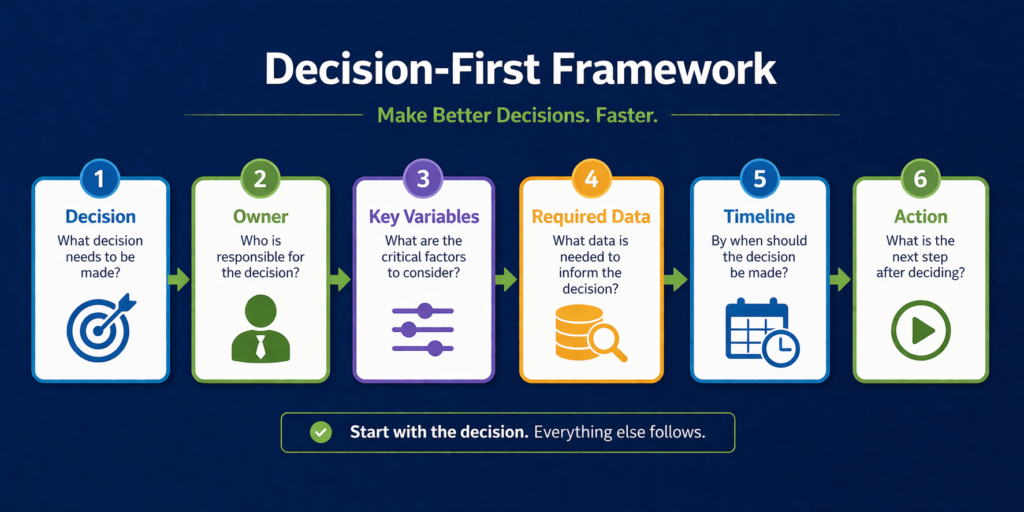
What works far better is a decision-first approach.
I use a simple structure before bringing any data into the discussion.
Step 1: Define the Decision Clearly
Start with:
What exactly are we trying to decide?
Not analysis. Not insight. A clear decision.
Example:
- Not: “Understand sales trend”
- But: “Should we increase price next month?”
Clarity here reduces unnecessary analysis later.
Step 2: Assign a Single Decision Owner
Every decision must have:
- one owner
- not a group, not a committee
Others can provide input, but ownership must be clear.
In one engagement, simply assigning a decision owner reduced meeting time by almost 40%.
Step 3: Identify Critical Variables (Not All Data)
Instead of looking at everything, focus on 2–4 variables that actually drive the decision
For example, in pricing:
- demand trend
- competitor price
- margin impact
Not 20 metrics. Just what matters.
This reduces noise significantly.
Step 4: Define Decision Timeline
Every decision should have a time boundary.
Without a timeline, analysis keeps expanding.
A simple rule I use:
“What is the best decision we can take with available data within this time?”
This shifts focus from perfection to action.
Step 5: Accept Incomplete Information
This is critical.
No decision will ever have 100% data.
Waiting for complete certainty is what creates anxiety.
Better approach:
- make the best possible call
- monitor outcome
- adjust if needed
This builds confidence and speed.
What Changed When We Applied This
In one client case, we replaced a detailed 25-slide dashboard with a decision sheet:
- decision
- owner
- 3 key variables
- recommended action
The impact was immediate:
- faster discussions
- fewer debates
- quicker closure
Not because we improved data.
But because we improved decision structure.
Final Thought
We often say: “Organizations need to become more data-driven.”
I think we need to rethink that.
Organizations don’t suffer from lack of data anymore.
They suffer from:
- too much input
- unclear ownership
- fear of being wrong
In trying to make decisions more rational, we have made them more emotionally difficult.
And that is the real issue.
If we want to fix this, we don’t need more dashboards.
We need:
- clearer decisions
- stronger ownership
- and the confidence to act without perfect data
Because more data, by itself, will not reduce anxiety.
In many cases, it will only increase it.
Leave a Reply