



Real-time reporting creates an illusion of control while distracting from decision-making, shifting focus to speed over relevance, priorities, and meaningful action.
Whenever I consult organizations around data and effective reporting mechanism, I get a recurring request from leadership teams across organizations: “We need real-time visibility.”
Real-time dashboards. Real-time financial reporting. Real-time operational metrics.
The underlying assumption is simple and rarely questioned: if we can see the numbers faster, we can make better decisions.
But after working closely with executives and finance teams on data and analytics initiatives, I have increasingly come to a different conclusion.
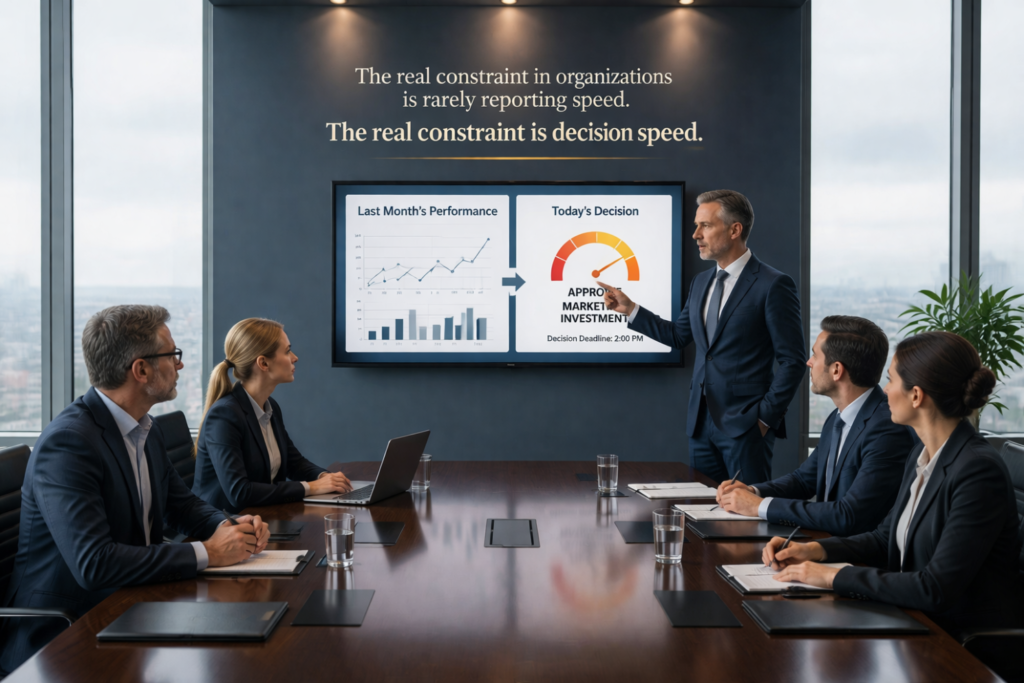
The real constraint in organizations is rarely reporting speed. The real constraint is decision speed.
And the two are not the same.
The Misdiagnosis of Organizational Delay
When decisions take time inside organizations, the immediate diagnosis is almost always the same: we do not have the data quickly enough.
This belief triggers a familiar sequence of investments. Companies begin building real-time data pipelines, live dashboards, automated reporting layers and integrated data platforms.
The expectation is that once data latency disappears, decision-making will accelerate.
Yet, something interesting happens after these systems go live.
The dashboards refresh every few hours. The numbers are available instantly. And yet, decisions continue to move at the same pace as before.
Why?
Because the real bottleneck was never the speed of reporting.
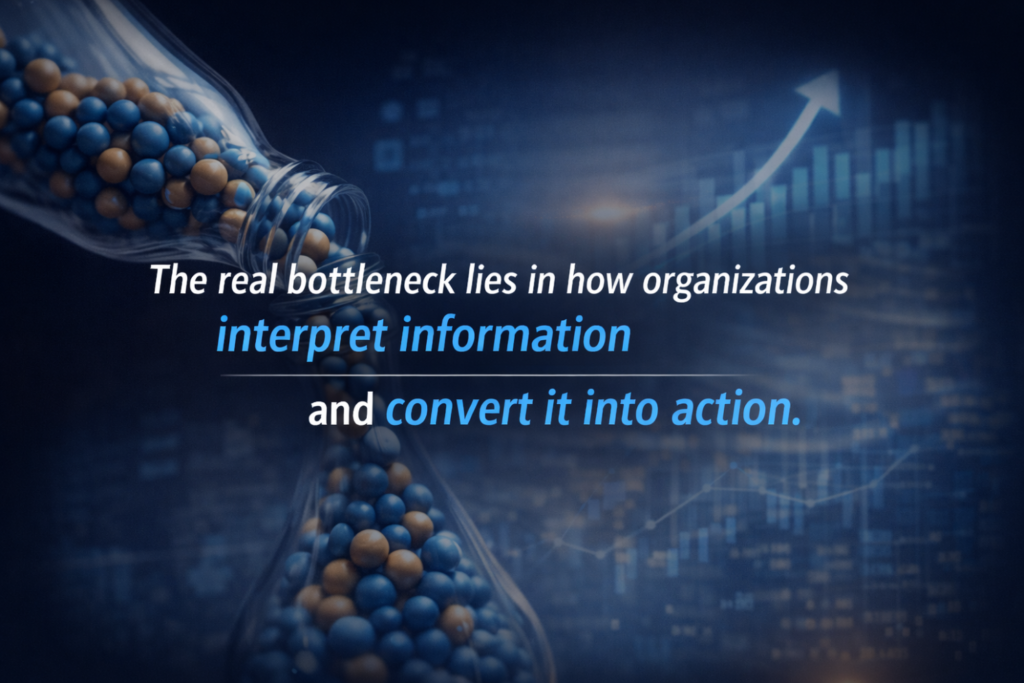
The real bottleneck lies in how organizations interpret information and convert it into action.
Understanding the Real Sources of Delay
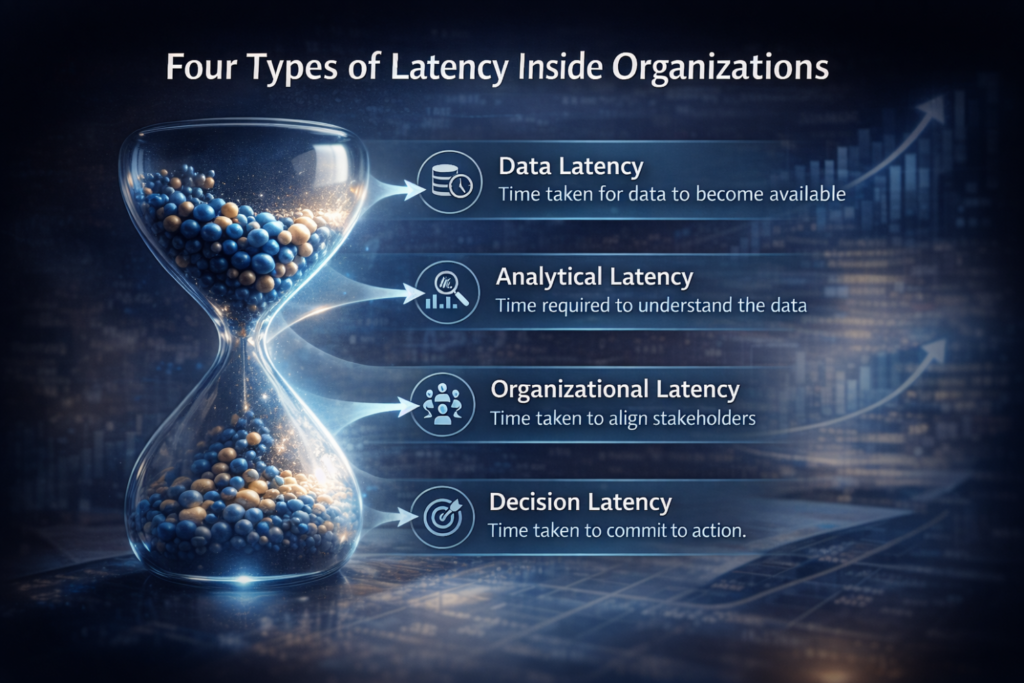
To understand this better, it helps to look at how decisions actually unfold inside organizations. In my experience, delays typically emerge from four different types of latency.
The first is data latency — the time it takes for data to become available. This is the problem most organizations focus on solving. And modern data infrastructure has become exceptionally good at reducing it.
But three other forms of latency are far more significant.
The second is analytical latency — the time required to understand what the data actually means. Numbers rarely explain themselves. Revenue may be down, margins may fluctuate, customer activity may spike or decline. But the underlying drivers are rarely obvious.
The third is organizational latency — the time required for multiple stakeholders to align on what the data implies. Strategy decisions often involve finance, operations, sales and leadership. Each group views the numbers through a different lens.
The fourth is decision latency — the time it takes for leadership to commit to a course of action.
Real-time reporting solves only the first of these four problems. The remaining three are where most decisions actually slow down.
The Dashboard Trap
Ironically, once organizations eliminate data latency, a new challenge often emerges.
I call this the dashboard trap.
When data becomes continuously available, leadership teams begin monitoring metrics far more frequently. Instead of periodic analysis, the organization shifts toward constant observation.
At first, this feels like progress. There is a sense of greater control and awareness.
But something subtle begins to happen.
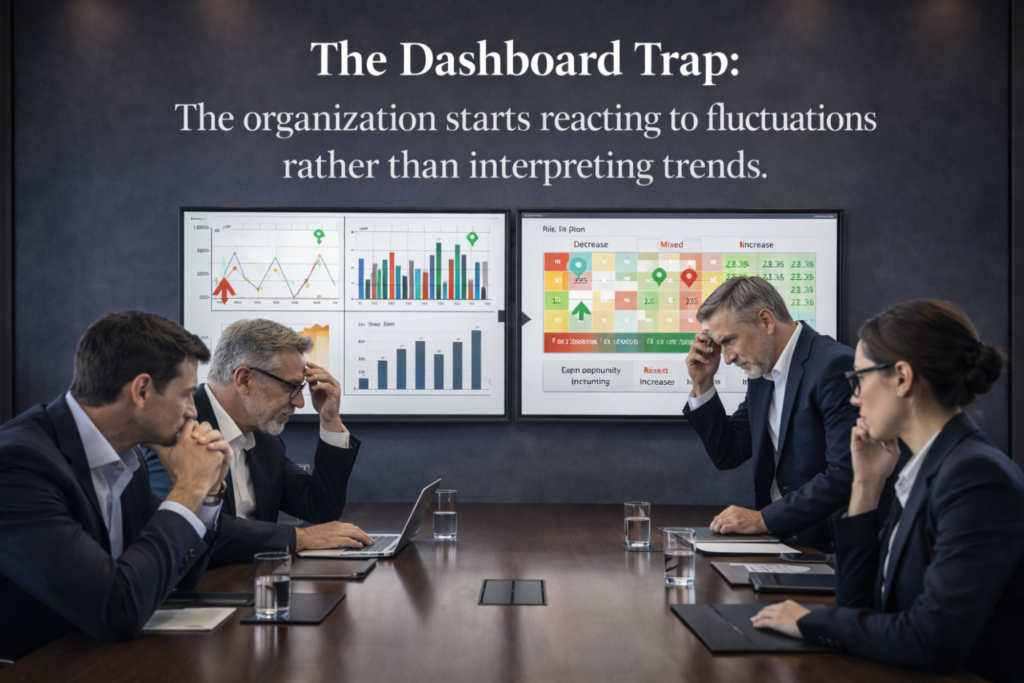
The organization starts reacting to fluctuations rather than interpreting trends.
Real-time numbers move constantly. Sales rise and fall throughout the day. Operational metrics fluctuate due to temporary conditions. Early financial indicators shift before the full picture becomes visible.
Without context, these signals are unstable.
And reacting to unstable signals often produces unstable decisions.
When Speed Amplifies Noise
A few months back, I worked with a leadership team that had invested heavily in building real-time performance dashboards. The system integrated data from multiple operational platforms and refreshed metrics continuously.
From a technical standpoint, it was impressive.
But within a few months, the executive team noticed an unexpected consequence.
Every minor variation in metrics began triggering discussions.
If a performance indicator dipped for a few hours, it became the focus of urgent attention. If a metric rose temporarily, teams rushed to interpret it as a trend.
Yet when we analyzed the patterns over longer periods, most of these fluctuations were simply noise.
Real-time visibility had increased awareness, but it had not increased understanding.
In fact, in some cases it had the opposite effect — it amplified short-term signals that were not strategically meaningful.
The Operational vs Strategic Data Divide
Another reason the obsession with real-time reporting is misplaced is that not all decisions operate on the same time horizon.
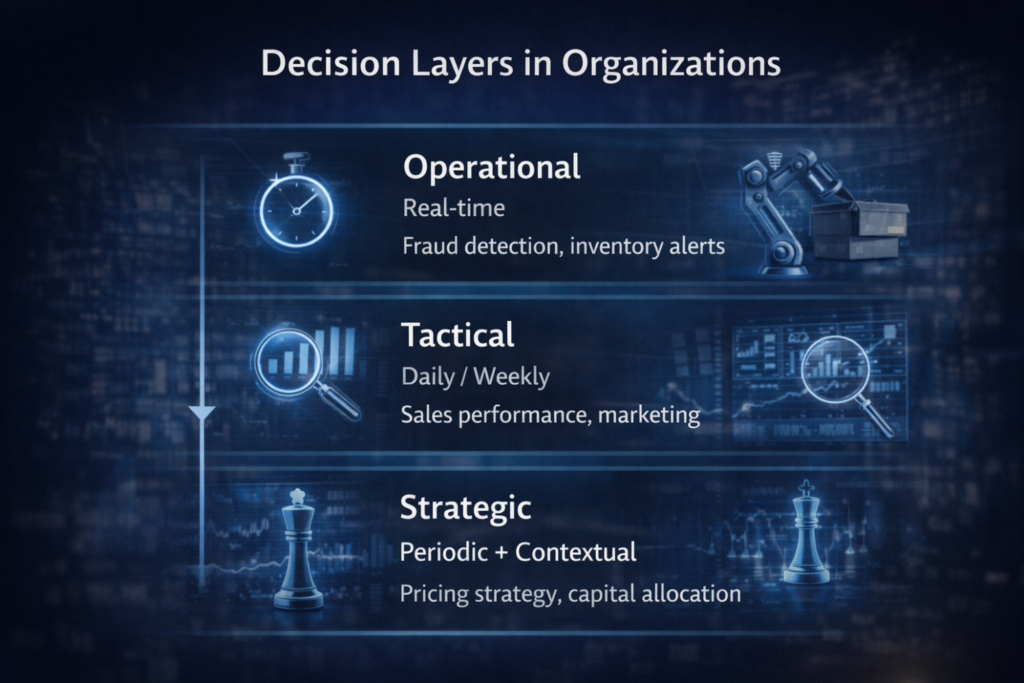
Inside most organizations, decisions happen across multiple layers. Yet the data infrastructure is often designed as if every decision requires the same level of immediacy.
In reality, the data requirements for operational actions are very different from those required for strategic choices.
Operational decisions often benefit from real-time data. These are situations where rapid response directly improves outcomes. Fraud detection systems must identify suspicious transactions immediately. Inventory systems may trigger alerts when stock levels drop below critical thresholds. In these cases, the speed of information directly determines the effectiveness of the response.
But many other decisions operate on a different cadence.
Sales performance reviews typically rely on daily or weekly aggregation. Leaders need to observe patterns across regions, products, and time periods before drawing conclusions. Moment-to-moment fluctuations rarely change the underlying business narrative.
Strategic decisions operate on an even longer horizon. Choices related to pricing strategy, capital allocation, market entry, or product portfolio shifts require a broader perspective. They demand historical context, comparative benchmarks, and scenario analysis.
The difference can be summarized simply:
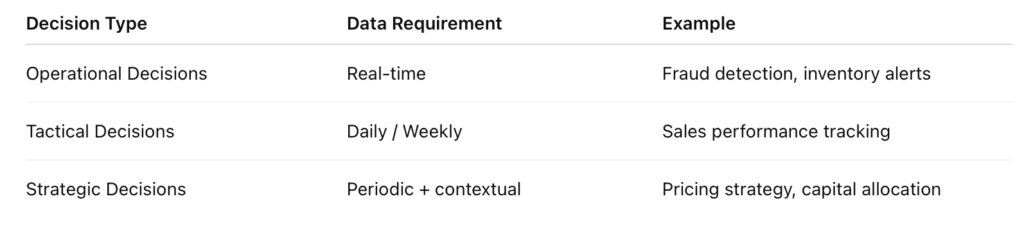
The problem arises when organizations attempt to apply operational data logic to strategic decision-making.
Real-time dashboards begin to dominate executive attention, even though the decisions they support are not time-critical.
Strategic decisions rarely fail because data arrived late. They fail because the data lacked context.
And context cannot be compressed into real-time feeds.
It emerges through analysis, interpretation, and structured discussion — processes that require reflection rather than immediacy.
Why Some of the Best Decisions Are Slow
In many cases, the highest quality decisions actually emerge from deliberate analysis rather than rapid reaction.
Patterns in business data often reveal themselves only after several cycles. Temporary fluctuations settle. Structural drivers become visible. Correlations evolve into clearer causal explanations.
Speed can be valuable when the signal is obvious and the response rule is predefined — for example in fraud detection, automated trading or operational monitoring.
But most leadership decisions are not structured this way.
They involve ambiguity, interpretation and judgment.
When organizations try to compress these processes artificially, they risk accelerating mistakes rather than improving outcomes.
From Reporting Systems to Decision Systems
Over time, I have become convinced that the real evolution organizations need is not faster reporting systems.
It is better decision systems.
Reporting systems answer a basic question: What happened?
Decision systems go much further. They attempt to answer:
- Why did it happen?
- What are the underlying drivers?
- What scenarios could unfold next?
- What actions are available to leadership?
This shift requires a different kind of analytics architecture — one that emphasizes driver analysis, scenario modeling and decision frameworks, not simply dashboards.
The competitive advantage in the next decade will not come from seeing numbers faster. It will come from interpreting them more intelligently than everyone else.

A Different Question for Leadership
When organizations discuss their analytics investments, the conversation often begins with a familiar request:
“Can we make this data available in real time?”
But there may be a more useful question to ask.
Are we designing systems that help leadership understand the data better?
Because in the end, real-time reporting can make organizations feel more informed.
But feeling informed is not the same as making better decisions.
And in strategy, clarity almost always matters more than speed.
Leave a Reply