


Data engineering is no longer backend IT plumbing; it is becoming strategic business infrastructure that determines data quality, AI scalability, and decision-making.
For years, data engineering has been treated as the plumbing of the enterprise.
Business teams define what they need. IT teams connect the systems. Data engineers build pipelines, maintain databases and make data available to analysts. Once the dashboard is delivered or the model goes into production, the data engineering work largely disappears from the business conversation.
That model worked when data was primarily used to produce reports.
It becomes increasingly inadequate when data is being used to run the business.
Today, a retailer wants to change prices based on demand signals. A manufacturer wants to anticipate equipment failures before production is disrupted. A bank wants to identify suspicious transactions as they happen. A CFO wants to understand profitability by customer, product and geography without waiting until the month-end close. An organization deploying AI wants its models and agents to work with current, contextual and trusted enterprise information.
In each of these situations, the quality of the business decision depends on something that is often discussed much earlier in the technology stack: the quality of the data engineering behind it.
This is why the role of data engineering is changing.
It is no longer simply about moving data from one system to another. It is increasingly about creating the data infrastructure through which an organization understands its business and makes decisions.
And that makes data engineering a business concern.
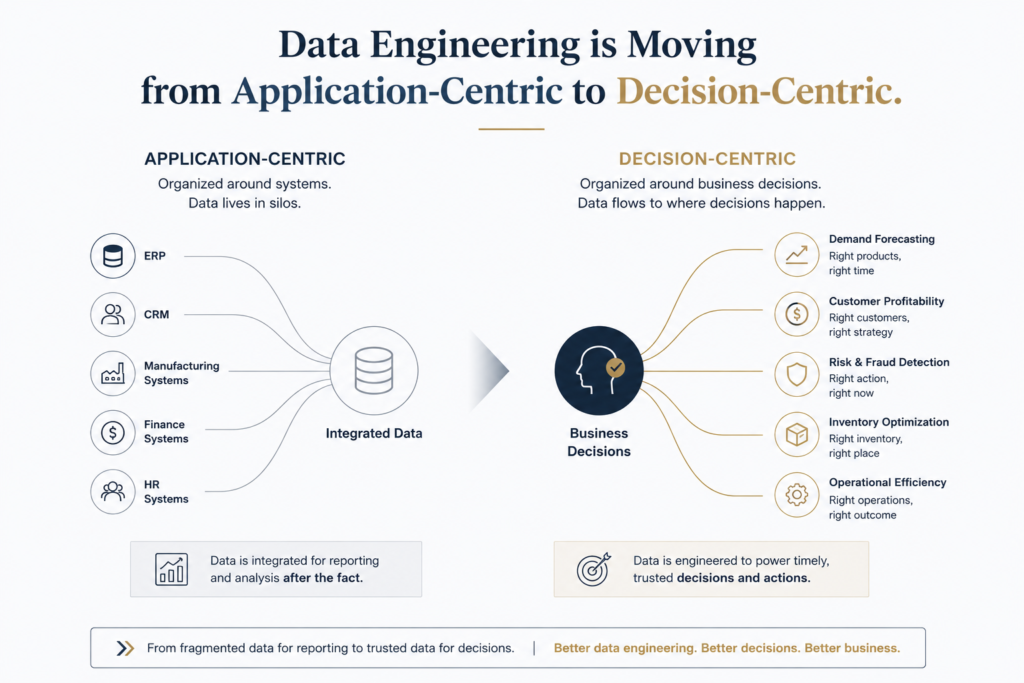
The uncomfortable truth – your analytics may not be the problem
Organizations frequently respond to poor business intelligence or disappointing AI outcomes by looking at the analytics layer.
Perhaps the dashboard is not intuitive enough. Perhaps the model needs to be retrained. Perhaps the organization needs a more sophisticated visualization tool. Perhaps it needs generative AI.
Sometimes that is true.
But increasingly, the problem sits underneath the analytics.
The customer data may be fragmented across multiple systems. Product definitions may differ between sales and finance. Historical data may be incomplete. Transaction data may arrive with delays. Different business units may calculate the same KPI differently. Data ownership may be unclear.
The organization then asks the analytics team to produce a single version of the truth from multiple versions of reality.
That is not an analytics problem.
It is a data engineering and business architecture problem.
A beautifully designed dashboard cannot correct an inconsistent business definition. A sophisticated machine-learning model cannot compensate indefinitely for unreliable input data. A generative AI application cannot provide dependable enterprise answers if the underlying information is fragmented, stale or poorly governed.
This leads to a simple but important observation:
The quality of the decision is often constrained by the quality of the data foundation long before the decision-maker sees the dashboard or AI interface.
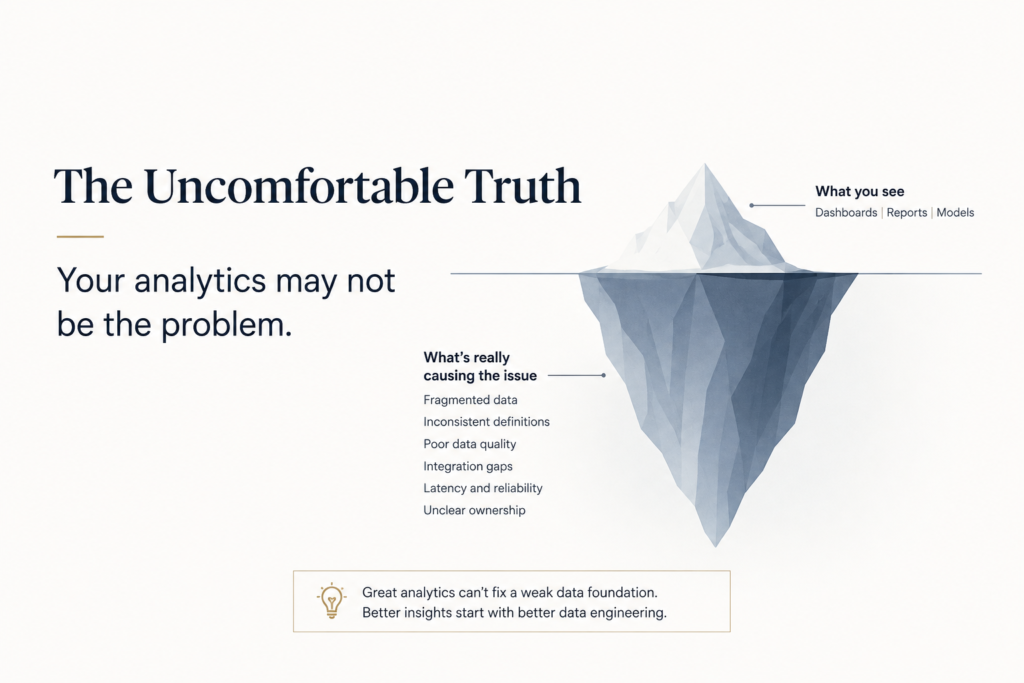
Data engineering is moving from application-centric to decision-centric
Most enterprise data environments have evolved around applications.
ERP data sits in one place. CRM data sits somewhere else. HR data has its own systems. Manufacturing has operational systems. Finance has its own data structures.
This is logical from a technology perspective because applications are where data originates.
But businesses do not make decisions application by application.
A supply-chain leader does not decide inventory levels by looking separately at ERP, procurement, sales and logistics systems. The decision requires an integrated view of demand, inventory, supplier performance, lead times, production capacity and logistics constraints.
Similarly, a CFO does not think about profitability in terms of individual source systems. The question is whether the organization can understand profitability across customers, products, channels, geographies and business units using consistent definitions.
This suggests a different way of thinking about enterprise data architecture:
The architecture should increasingly be designed around the decisions the business needs to make, not merely around the systems the business happens to operate.
That changes the questions data engineering teams need to ask.
Instead of:
- Where does the data reside?
- How do we move it?
- Which technology should we use?
the conversation needs to include:
- Which business decision are we trying to improve?
- What information is required to make that decision?
- How frequently does the information need to be refreshed?
- What level of accuracy is required?
- Who owns the underlying data?
- How will the decision-maker know that the information can be trusted?
The difference may appear subtle.
It is not.
It changes data engineering from a technology delivery activity into a business capability.
Data quality has become a management issue
Data quality is often treated as a technical metric.
Teams measure completeness, accuracy, consistency, duplication and freshness. Data-quality dashboards are created. Exceptions are logged. Remediation processes are established.
All of this is necessary.
But there is a bigger question that organizations often overlook: Is the data fit for the decision for which it is being used?
Consider a customer profitability calculation.
The organization may have almost complete revenue data. Yet if discounts, returns, service costs and acquisition costs cannot be consistently attributed to the same customer, the resulting profitability measure can be misleading.
Or consider a demand forecasting model. The underlying data may be accurate, but if it is available three days after the planning decision has already been made, its accuracy has limited business value.
Data quality therefore needs to move from being a technical housekeeping exercise to becoming part of business governance.
A useful way to think about it is: Data quality should be measured against the consequence of the decision it supports.
A minor data discrepancy in an exploratory analysis may be acceptable. The same discrepancy could be unacceptable in a regulatory report, financial forecast or credit decision.
This means business leaders need to participate in defining data quality standards, priorities and ownership.
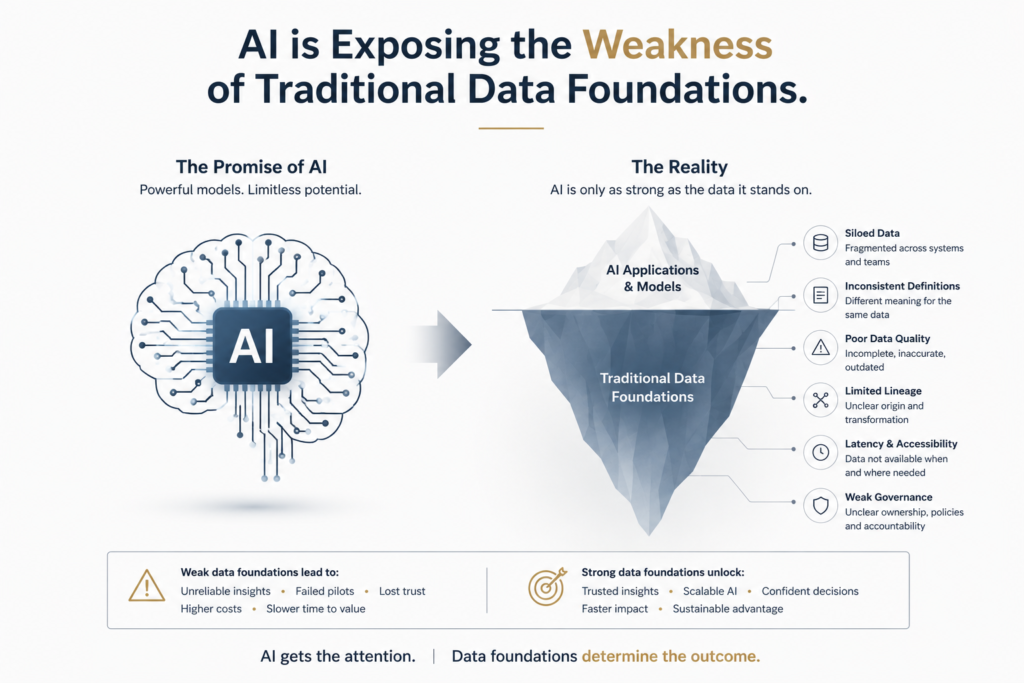
AI is exposing the weakness of traditional data foundations
The AI conversation has made this shift even more important.
Organizations have invested heavily in large language models, predictive analytics, AI copilots and increasingly autonomous AI applications. Yet many are discovering that getting an AI pilot to work is considerably easier than integrating it into the enterprise.
The reason is straightforward.
Enterprise AI needs enterprise context.
A sales AI assistant may require customer history, opportunity information, product data, pricing, previous interactions and external market information.
A finance AI assistant may need financial statements, transaction data, accounting policies, management reports and approved business definitions.
A manufacturing AI application may require production data, quality records, maintenance history, machine signals and supply-chain information.
The AI model is only one component of the architecture.
The harder problem is often ensuring that the right information reaches the model at the right time, in the right context, with appropriate security and sufficient reliability.
This is where data engineering becomes strategically important.
AI does not eliminate the need for good data engineering. It increases the penalty for not having it.
This is also why many organizations will discover that their AI strategy is constrained not by the availability of AI models, but by the maturity of their data environment.
From data pipelines to decision pipelines
This may be the most important conceptual shift for data engineering.
The traditional objective of a pipeline is to move data from source to destination.
The emerging objective is to move trusted information into a decision process.
Consider a working-capital decision.
The organization may need:
- current inventory levels,
- open purchase orders,
- historical demand,
- customer orders,
- supplier lead times,
- production schedules,
- payment behaviour and
- demand forecasts.
The engineering challenge is not simply to bring these datasets together.
The real challenge is to create a reliable flow of information that enables the organization to decide where inventory should be increased, reduced or reallocated.
The same principle applies across functions.
| Business decision | Data engineering implication |
|---|---|
| Which customers are becoming unprofitable? | Integrate revenue, discount, service and cost data around a common customer definition |
| Which machines are likely to fail? | Combine sensor, maintenance, production and equipment-history data |
| Which transactions require investigation? | Make relevant transaction and behavioural data available with appropriate latency |
| Where should inventory be increased? | Connect demand, inventory, supply and production information |
| Which opportunities deserve sales attention? | Integrate customer, pipeline, engagement and commercial history |
The data pipeline is therefore no longer just a technical asset.
It becomes part of the decision mechanism.
This requires a different operating model
If data engineering remains entirely separated from business teams, organizations will continue to optimize technology components rather than business outcomes.
A stronger model brings together four capabilities:
Business domain expertise to define the problem and decision.
Data engineering to create the reliable data foundation.
Analytics and AI to generate the insight or prediction.
Technology and product teams to embed the resulting capability into the workflow.
The objective is not to create another committee.
It is to create shared accountability for the outcome.
For example, if the business objective is to improve customer profitability, the team should not consist only of data engineers waiting for requirements from finance. It should include people who understand customer economics, data architecture, analytics and the operational process through which pricing, retention or service decisions are made.
The unit of delivery should increasingly be a business capability, rather than a data pipeline.
That is a significant shift in operating philosophy.
The metrics need to change too
If data engineering is treated as an IT function, its success is naturally measured through technology metrics:
- Pipeline availability
- Processing latency
- Data volumes
- Infrastructure cost
- Incident resolution
- System uptime
These metrics are important. But they tell only part of the story.
If data engineering is a business capability, the organization should also ask:
- How much faster can management make the decision?
- How much manual reconciliation has been eliminated?
- Has forecast accuracy improved?
- Has revenue leakage declined?
- Has fraud detection become faster?
- Has inventory availability improved?
- How quickly can a new analytical use case be deployed?
- How much faster can an AI solution move from pilot to production?
This changes the conversation from “Did we deliver the pipeline?” to “What changed in the business because the pipeline exists?”
That is the difference between technology delivery and business value.
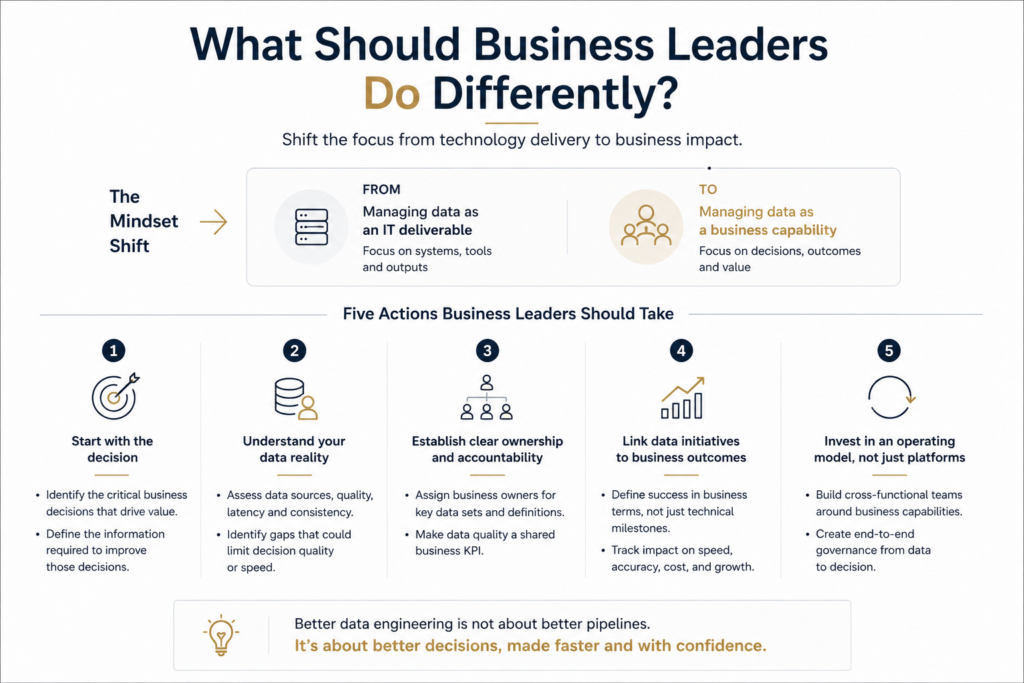
What should business leaders do differently?
Business leaders do not need to understand every component of a modern data stack.
They do, however, need to become much more deliberate about the data foundations behind their strategic initiatives.
Before approving a major analytics or AI program, five questions can reveal whether the organization is actually ready:
- What decision are we trying to improve?
- What information is required to make that decision?
- Do we have reliable access to that information today?
- Who owns the data and the business definition behind it?
- How will we measure whether the decision actually improved?
These questions sound simple, but they force organizations to connect technology investment with business value.
They also expose a common organizational problem: companies often invest in data capabilities before deciding which decisions they want those capabilities to improve.
The result is predictable.
More platforms. More dashboards. More data. More AI pilots.
But not necessarily better decisions.
The strategic implication
The next competitive advantage in data and AI may not come from having access to better technology. Increasingly, it may come from having a better data operating model.
Technology is becoming easier to access. Cloud platforms are becoming increasingly standardized. AI models are becoming more capable and more accessible. Analytics tools are becoming easier for business users to adopt.
What remains difficult is creating an enterprise environment where trusted data can continuously move from operational systems into insights, decisions and actions.
That requires more than technology.
It requires business ownership, strong data engineering, clear definitions, effective governance and a deep understanding of how decisions are actually made.
This is why the debate over whether data engineering belongs to IT or the business is becoming less useful.
The more important question is:
Is the organization treating data engineering as part of its business architecture?
Because when data determines what the organization can see, what it can predict and how quickly it can respond, data engineering is no longer simply maintaining the pipes.
It is helping determine what the business is capable of knowing and doing.
And that makes it a business function.
Leave a Reply