



Organizations don’t need more data; they need better data. Strategic deletion, not indiscriminate collection, creates lasting business value.
For nearly two decades, one phrase has shaped enterprise data strategy more than any framework, methodology, or technology trend: “Data is the new oil.”
It is a powerful analogy. Just as oil fuelled the industrial revolution, data has become the fuel of the digital economy. Business leaders were encouraged to collect as much information as possible, store it indefinitely, and assume that its value would eventually be unlocked through analytics, machine learning, or, more recently, Artificial Intelligence.
This philosophy fundamentally changed how organizations approached information. Every customer interaction, every transaction, every website click, every sensor reading, every application log, and every email became something worth preserving. Cloud storage became cheaper, data lakes became larger, and the prevailing belief was simple: you never know when you’ll need the data.
That assumption made perfect sense when organizations were trying to become data-driven.
Today, however, it deserves to be challenged.
The reality is that most enterprises are no longer suffering from a shortage of data. They are suffering from an excess of it. Instead of creating competitive advantage, massive volumes of poorly governed information are increasing operational complexity, inflating technology costs, expanding cybersecurity risks, and making AI initiatives harder—not easier—to succeed.
Perhaps it is time to replace one of the most celebrated statements in analytics with a more uncomfortable one:
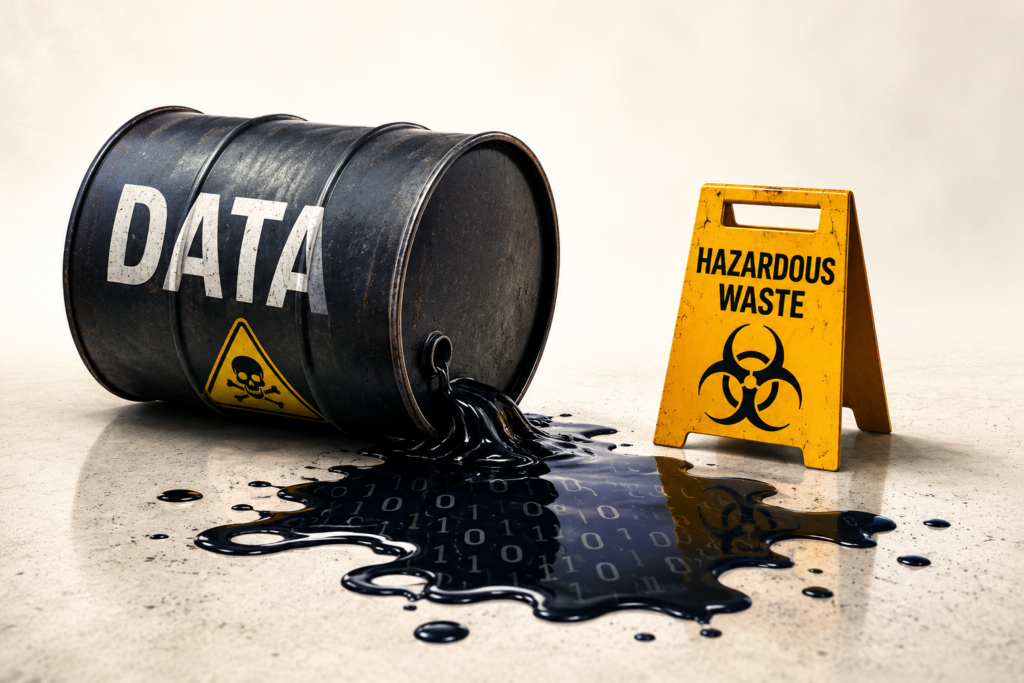
Data is not the new oil. Increasingly, it resembles hazardous waste.
Not because data lacks value, but because data that no longer serves a business purpose becomes expensive to store, difficult to govern, vulnerable to attack, and risky to retain.
The next generation of data leaders may not be remembered for building the biggest data platforms. They may be remembered for having the discipline to build the cleanest ones.
We Have Mistaken Data Volume for Business Value
For years, organizations have measured their data maturity by asking questions such as:
- How many systems have we integrated?
- How much data have we collected?
- How large is our data lake?
- How many years of historical information do we retain?
These metrics may demonstrate technical capability, but they say very little about business value.
Collecting more data does not automatically improve decision-making. In fact, beyond a certain point, additional data often creates diminishing returns. Business users spend more time searching for trustworthy information than acting upon it. Analysts waste hours reconciling conflicting datasets. Executives receive multiple reports showing different versions of the same KPI.
The problem is rarely that organizations lack information. More often, they lack confidence in the information they already possess.
A retailer with twenty years of transaction history does not necessarily make better pricing decisions than one with five years. A manufacturer storing billions of machine logs is not automatically better at predictive maintenance. Likewise, a bank preserving every customer interaction since its inception does not inherently deliver better customer experiences.
The differentiator is not the volume of information—it is the ability to identify which information genuinely improves decisions.
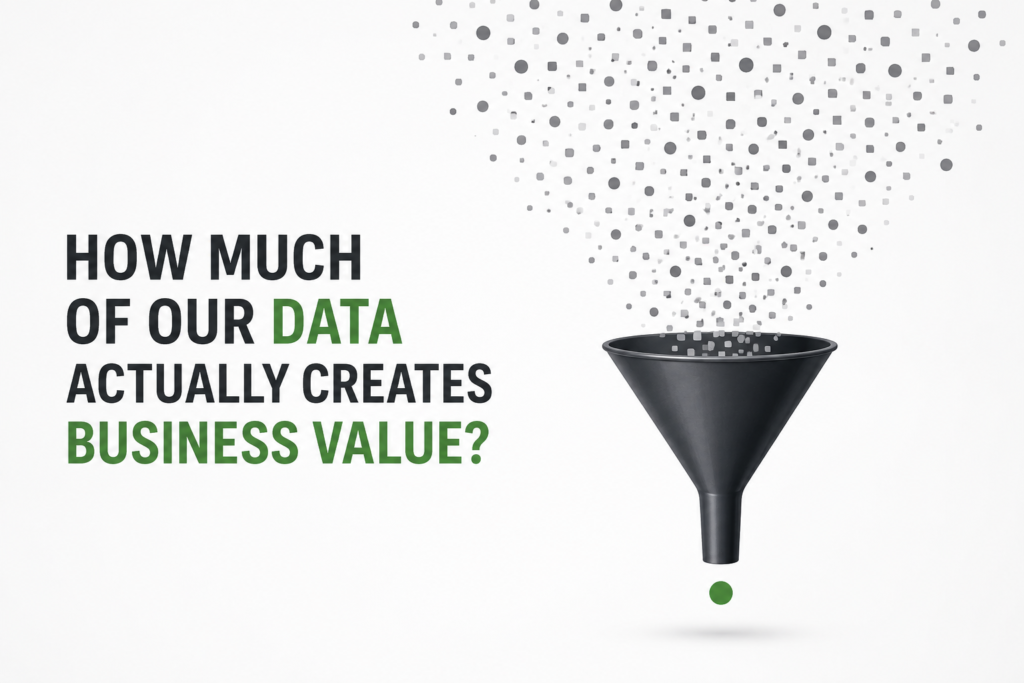
Organizations should stop asking, “How much data do we have?”
Instead, they should ask, “How much of our data actually creates business value?”
The answers are often surprisingly uncomfortable.
The Hidden Cost of Data Nobody Budgets For
When executives discuss the economics of data, the conversation usually begins and ends with storage costs. Because cloud storage has become relatively inexpensive, retaining everything appears to be a rational decision.
However, storage is only the visible tip of a much larger iceberg.
Every dataset an organization retains creates a chain of ongoing responsibilities that continue for years. Those responsibilities include:
- Protecting the data from cyber threats.
- Backing it up and ensuring disaster recovery.
- Maintaining metadata and business definitions.
- Monitoring data quality and integrity.
- Managing access permissions and governance.
- Migrating it whenever technology platforms change.
- Demonstrating compliance during audits and regulatory reviews.
Each of these activities consumes time, people, technology, and budget.
Individually, the costs may appear manageable. Collectively, they represent one of the largest hidden operational expenses within modern enterprises.
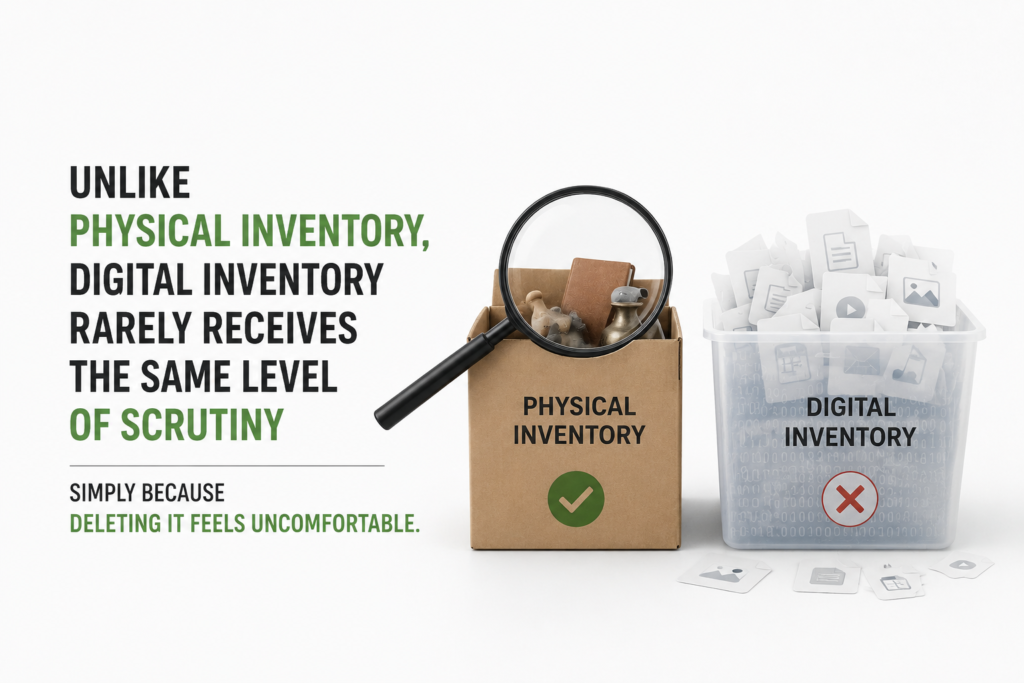
Imagine a manufacturing company continuing to pay warehouse rent for obsolete inventory that no customer wants and no employee uses. Most leadership teams would immediately initiate an inventory rationalization exercise.
Yet many organizations maintain digital warehouses filled with datasets that have not been accessed in years.
Unlike physical inventory, digital inventory rarely receives the same level of scrutiny simply because deleting it feels uncomfortable.
That hesitation is becoming increasingly expensive.
Every Additional Dataset Expands Your Attack Surface
Organizations often respond to increasing cyber threats by investing in stronger security technologies. Firewalls become smarter, identity management becomes stricter, and security operations centres become more sophisticated.
These investments are essential.
However, they often overlook one simple principle:
The safest sensitive data is the data that no longer exists.
Every customer record, employee file, supplier contract, historical transaction, archived document, or forgotten backup becomes another asset that must be protected.
Every additional dataset creates another potential entry point for attackers.
If a breach occurs, the consequences are directly proportional to the amount of sensitive information an organization has chosen to retain.
A mature cybersecurity strategy should therefore include more than detection and prevention. It should also include elimination.
Leaders should regularly ask questions such as:
- Which datasets are no longer supporting business operations?
- Which historical records have exceeded their retention requirements?
- Which duplicated datasets continue to exist simply because nobody owns them?
- Which reports have not been opened in the past two years?
Deleting unnecessary information is not merely an IT housekeeping exercise.
It is a business risk reduction strategy.
Compliance Rewards Discipline, Not Hoarding
Privacy regulations have fundamentally changed the economics of enterprise data.
Whether organizations operate under GDPR, CCPA, India’s Digital Personal Data Protection Act, or industry-specific regulations, one principle appears consistently:
Retain only the information you genuinely need.
Unfortunately, many organizations continue operating under assumptions developed long before these regulations existed. They believe retaining more information provides greater flexibility for future analytics.
In reality, excessive retention often creates additional compliance obligations.
The more personal information an organization stores, the greater the burden associated with:
- Responding to customer deletion requests.
- Managing consent records.
- Supporting legal discovery.
- Conducting privacy audits.
- Reporting data breaches.
- Demonstrating appropriate retention policies.
Compliance teams frequently discover that their biggest challenge is not protecting active business data.
It is identifying and managing information that should have been deleted years earlier.
The irony is striking.
Many organizations spend millions protecting data that contributes little or nothing to their current business operations.
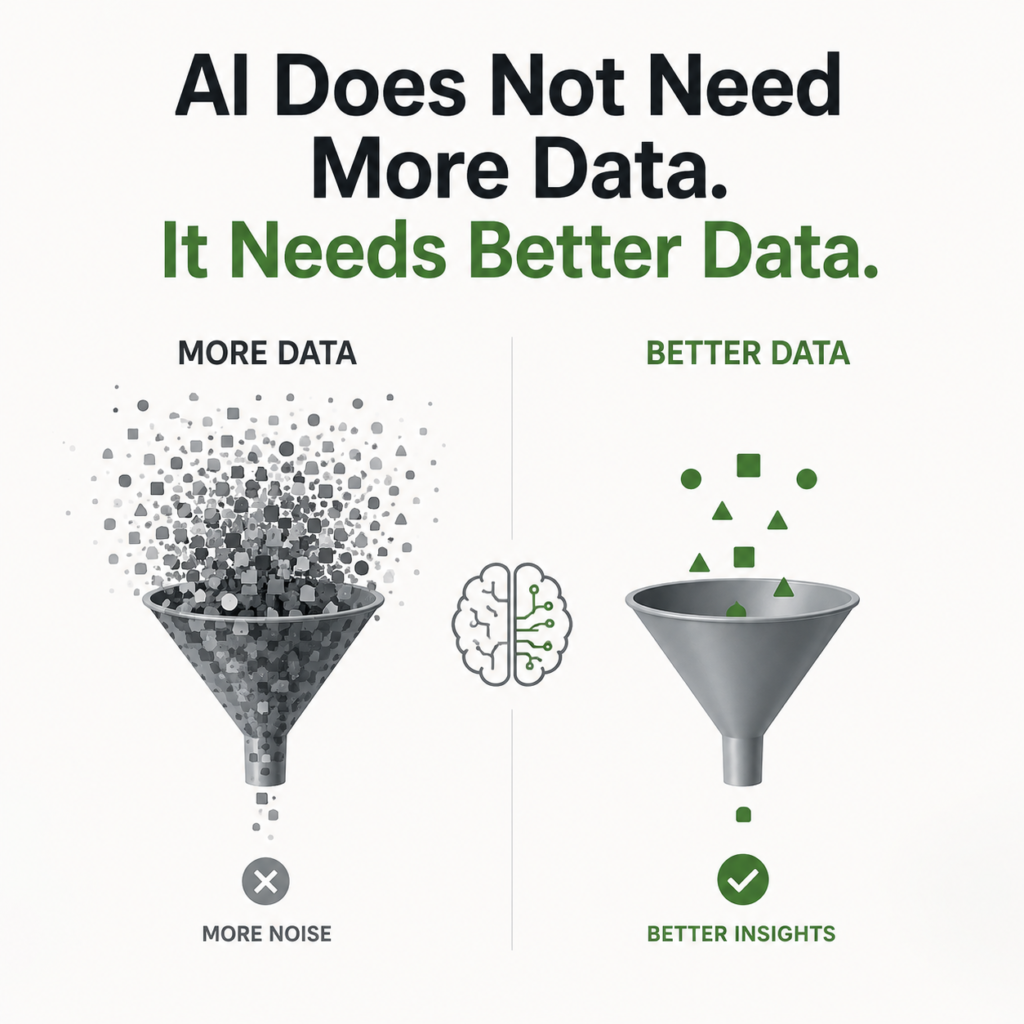
AI Does Not Need More Data. It Needs Better Data.
The emergence of Generative AI has reignited the belief that organizations should collect even more data.
The assumption sounds logical.
If AI thrives on information, surely more information must produce better intelligence.
Not necessarily.
Artificial Intelligence is remarkably effective at analysing information.
It is not remarkably effective at determining whether that information is accurate, current, relevant, or consistent.
Poor-quality enterprise data remains poor-quality enterprise data, regardless of how sophisticated the AI model becomes.
Successful AI initiatives depend far more on characteristics such as:
- High data quality.
- Clear business context.
- Well-defined ownership.
- Consistent governance.
- Reliable master data.
- Trusted business definitions.
Organizations frequently underestimate how much time AI projects spend cleaning, validating, and reconciling enterprise information before any meaningful insights can be generated.
Collecting additional data rarely solves these problems.
Improving existing data often does.
The question leaders should ask is no longer, “What more can we collect?”
It is, “What should we stop collecting?”
Data Minimalism Is the Next Stage of Data Maturity
Minimalism transformed manufacturing through lean operations.
It transformed software engineering by reducing unnecessary complexity.
It transformed product design by focusing relentlessly on user value.
Enterprise data strategy is now ready for a similar transformation.
Data minimalism does not advocate collecting less information indiscriminately.
It advocates retaining only information that continues to justify its existence.
Every significant dataset should periodically answer five simple questions:
- Does it support an active business process?
- Is someone accountable for its quality?
- Does it improve operational or strategic decision-making?
- Is there a regulatory or contractual reason to retain it?
- Is there a clearly defined date when it should be archived or permanently deleted?
If the answers to these questions remain unclear, organizations should challenge whether the dataset belongs in their ecosystem at all.
Data should no longer receive indefinite residency simply because storage is inexpensive.
It should continuously earn its place.
That represents a significant shift in thinking—from data accumulation to data stewardship.
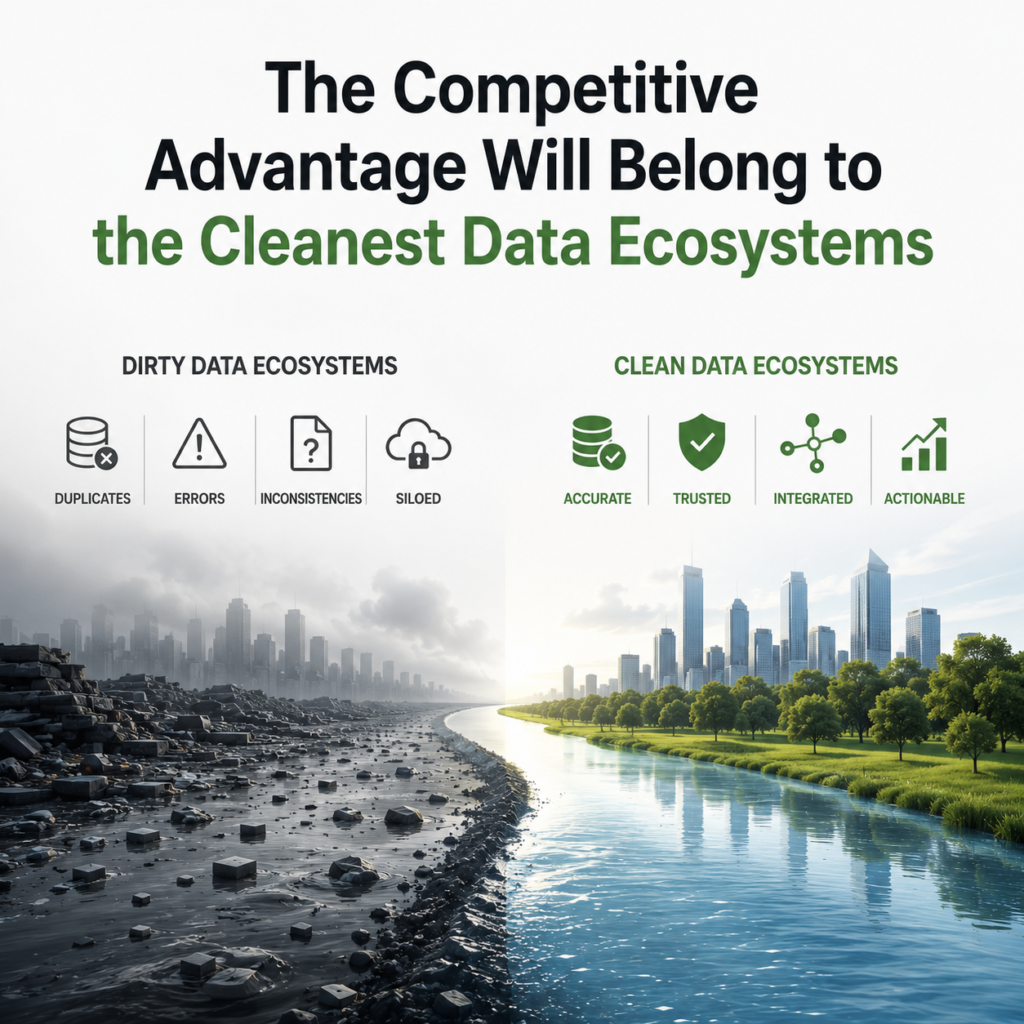
The Competitive Advantage Will Belong to the Cleanest Data Ecosystems
For years, organizations have competed to build larger data lakes, integrate more systems, and capture more information.
The next phase of enterprise analytics will look very different.
Competitive advantage will increasingly come from simplicity rather than scale.
Organizations with cleaner, well-governed, high-quality data ecosystems will develop AI solutions faster, produce more trusted analytics, reduce cybersecurity exposure, simplify compliance, and enable quicker business decisions.
- Their analysts will spend less time searching for information.
- Their executives will spend less time debating whose numbers are correct.
- Their AI initiatives will spend less time cleaning data and more time generating value.
Most importantly, their technology investments will produce greater business outcomes because complexity will no longer stand in the way.
Data maturity should no longer be measured by the number of terabytes an organization stores.
It should be measured by the percentage of enterprise data that actively contributes to business value.
That is a far more meaningful metric.
Final Thoughts
The phrase “Data is the new oil” served the industry well during a time when organizations needed encouragement to invest in data.
Today, the challenge has changed.
Very few enterprises need encouragement to collect more information. Most already possess more data than they can effectively govern, secure, analyse, or use.
The conversation therefore needs to evolve.
The future will not belong to organizations that preserve every byte they create. It will belong to organizations that develop the discipline to distinguish between valuable assets and digital clutter.
Oil becomes more valuable after refinement. Hazardous waste becomes more dangerous the longer it is ignored.
Enterprise data behaves much the same way. The information that supports decisions, improves customer experiences, drives innovation, and creates competitive advantage should absolutely be preserved and enriched. Everything else should be evaluated, governed, archived where necessary, and, when its purpose has been fulfilled, responsibly deleted.
In an era obsessed with collecting more, perhaps the most strategic data initiative an organization can undertake is not building another data lake.
It is having the courage to drain part of the one it already has.
Leave a Reply