



AI investment creates value only when it improves critical decisions, strengthens execution, and delivers measurable business outcomes.
Companies are investing heavily in artificial intelligence while many of the fundamental problems that prevent them from making better decisions remain largely unchanged. Data continues to sit across disconnected systems. Business functions continue to work with different definitions and fragmented processes. Executives continue to receive large volumes of information without always having a clear view of what requires action.
Yet the response is increasingly to invest in more AI.
This does not mean that AI investments are misplaced. Artificial intelligence will undoubtedly change how organizations work, how employees access information, how decisions are made and how products and services are delivered. Companies that ignore its potential will eventually find themselves at a disadvantage.
The concern is different.
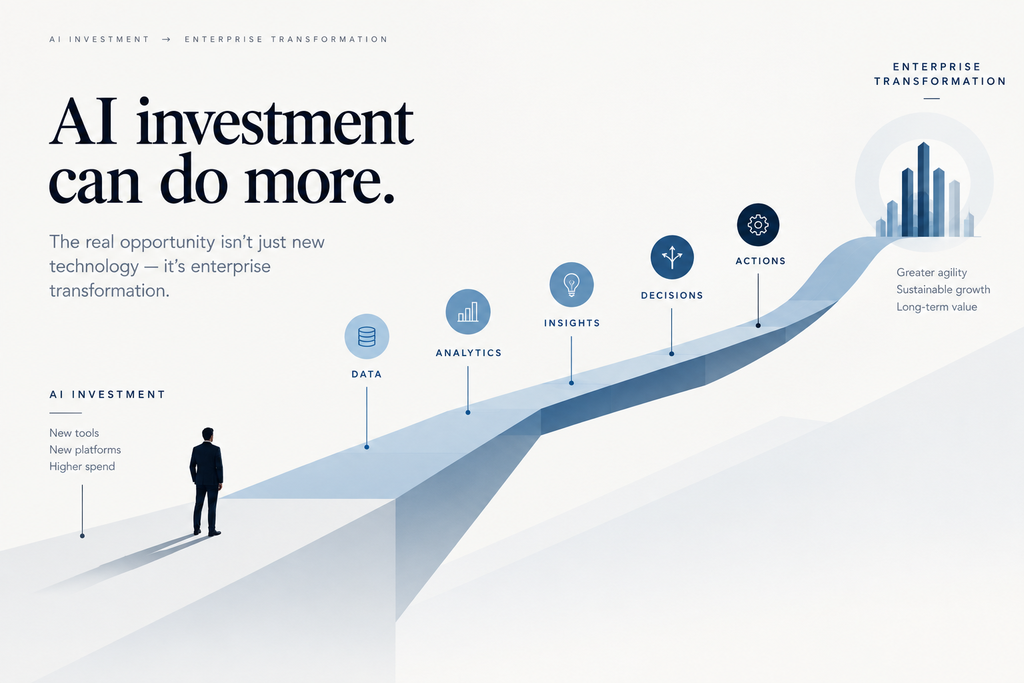
AI is increasingly being treated as the starting point for transformation when, in many cases, it should be one component of a much broader transformation agenda.
The more important question for executives is therefore not simply how much they should invest in AI.
It is:
Where can better intelligence create measurable business value, and what role should AI play in creating it?
The Technology-First Trap
Every major technology cycle creates a temptation to begin with the technology.
When cloud computing became mainstream, organizations began asking what they could move to the cloud. When analytics became a strategic priority, companies began asking where they could deploy dashboards and predictive models. Today, the question has become – where can we deploy AI?
There is nothing inherently wrong with experimentation. In fact, experimentation is essential when a technology is evolving as quickly as AI.
The problem begins when experimentation becomes the strategy.
Organizations can end up with an impressive portfolio of AI initiatives without having a clear understanding of which business decisions they are improving. Different functions launch different applications, employees adopt different tools and technology teams build increasingly sophisticated capabilities. The organization becomes visibly more “AI-enabled”, but the connection between these initiatives and business performance can remain surprisingly weak.
This is where the investment conversation needs to change.
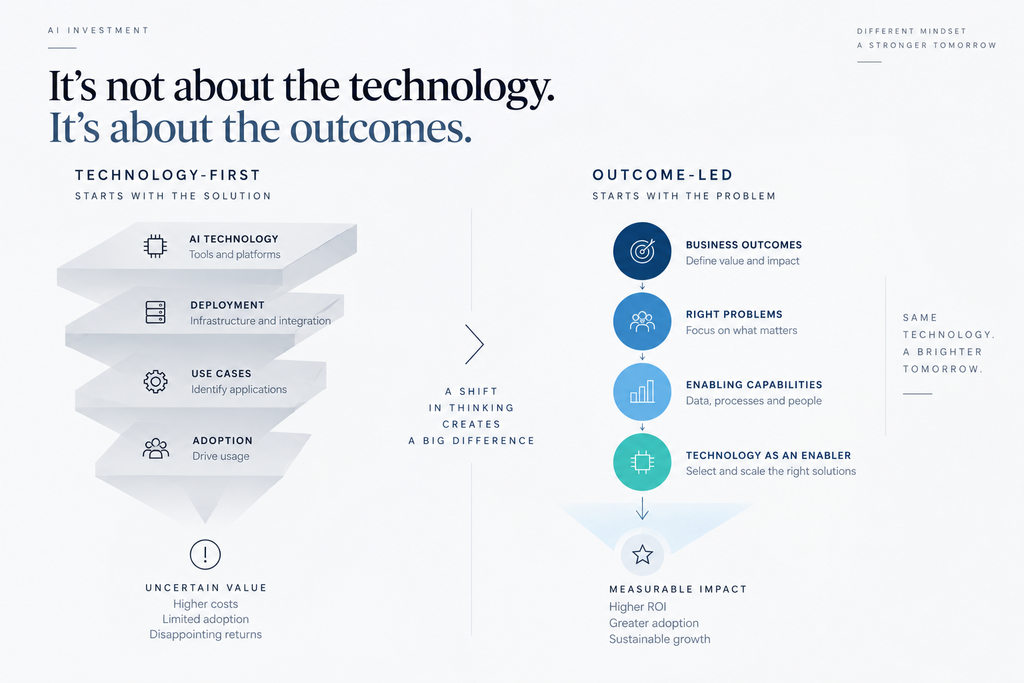
From technology-led investment to outcome-led investment
| Technology-first approach | Outcome-led approach |
|---|---|
| Start with the technology | Start with the business outcome |
| Identify AI use cases | Identify critical business decisions |
| Measure adoption | Measure business impact |
| Focus on productivity | Focus on decision economics |
| Build individual AI applications | Build connected intelligence capabilities |
| Ask “Where can we use AI?” | Ask “Where can AI create incremental value?” |
The difference is more than semantic.
In the first model, the organization has a technology looking for a problem. In the second, the organization has a business problem and is determining which capabilities—including AI—are appropriate to solve it.
That is a fundamentally different investment philosophy.
The Real Gap Is Often Not Intelligence, but Decision-Making
Consider a commercial organization that knows its sales have declined in a particular region.
It already has dashboards showing the decline. Its analytics team can segment customers, examine historical trends and identify the products contributing to the change. An AI system can now go further by summarizing the information, generating explanations and suggesting potential actions.
Yet the organization may still struggle with the most important question:
What should the commercial team actually do differently?
Should sales resources be moved to another segment? Should pricing change? Should certain customers receive additional attention? Should marketing investment be redirected? Should the product portfolio be adjusted?
These are not purely analytical questions. They are business decisions involving trade-offs, constraints, ownership and consequences.
AI can help inform those decisions, but it does not automatically create the decision system around them.
This distinction becomes increasingly important as organizations become capable of generating intelligence at unprecedented speed. The bottleneck may no longer be the ability to produce information. It may be the organization’s ability to interpret that information, make a decision and convert the decision into coordinated action.
The problem, in other words, may not be insufficient intelligence.
It may be insufficient decision capability.
The Intelligence-to-Action Gap
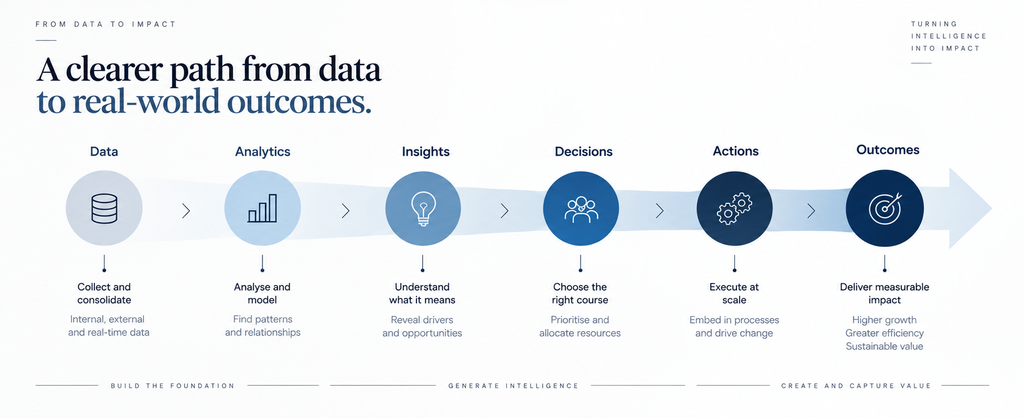
This can be represented simply: DATA → ANALYTICS → INSIGHTS → DECISIONS → ACTIONS → OUTCOMES
AI can potentially strengthen several stages of this chain.
But it cannot automatically make the chain work.
If the organization identifies an insight but nobody owns the decision, the insight has limited value. If the decision is made but the operating process does not support execution, the value is lost again. If an action is taken but there is no mechanism for measuring the outcome, the organization cannot determine whether the intervention worked.
This creates what can be called the intelligence-to-action gap.
| Stage | Typical organizational question | Potential AI contribution |
|---|---|---|
| Data | What information do we have? | Data discovery and extraction |
| Analytics | What is happening? | Pattern identification and analysis |
| Insights | Why is it happening? | Explanation and synthesis |
| Decision | What should we do? | Recommendations and scenario support |
| Action | How should we execute? | Workflow assistance and automation |
| Outcome | Did it work? | Monitoring and learning |
The important point is that AI is not the system itself. It is a capability that can strengthen the system.
AI Cannot Compensate for Weak Foundations
There is a second issue that deserves greater attention.
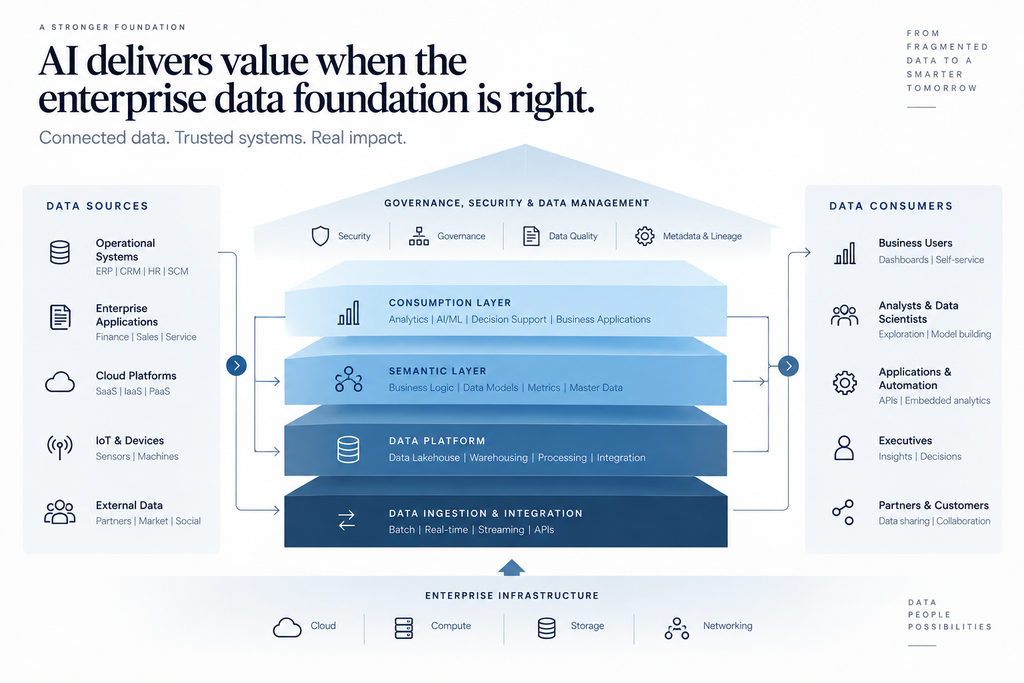
AI systems operate within an organizational environment shaped by data, processes, systems and governance. If those foundations are weak, the quality and usefulness of AI will inevitably be constrained by them.
Take a large enterprise with multiple customer databases. Marketing has one customer hierarchy, sales has another and finance uses a third. Product definitions differ across business units. Historical data contains inconsistencies. Critical information is still exchanged through spreadsheets and email.
The organization can introduce an advanced AI platform on top of this environment. It can make information easier to access and considerably faster to process.
But it has not necessarily solved the underlying problem.
In some cases, it has simply created a more sophisticated interface to an imperfect information environment.
That is why investments in data architecture, governance, integration, semantic consistency and process design remain strategically important in an AI-driven enterprise.
The foundation still matters
| Business constraint | Capability required |
|---|---|
| Fragmented information | Data architecture and integration |
| Inconsistent definitions | Data governance and semantic models |
| Poor data quality | Data management and quality controls |
| Disconnected processes | Process redesign |
| Weak analytical understanding | Analytics and diagnostic capabilities |
| Slow or inconsistent decisions | Decision intelligence |
| Repetitive knowledge work | AI augmentation or automation |
These are not competing investments. They are complementary capabilities.
An organization does not become AI-ready simply because it has purchased an AI platform.
It becomes AI-ready when the surrounding data, processes, decision structures and governance allow AI to produce reliable and actionable value.
The Productivity Trap
Much of the early business case for generative AI has understandably focused on productivity.
If an employee can prepare a report in twenty minutes instead of two hours, the benefit appears obvious. If a service agent can resolve a customer query faster, the economics appear equally compelling.
But productivity is only valuable when it changes the economics of the business.
Saving time does not automatically create value. The organization must determine what happens to that time.
Does the employee use it to make better decisions? Serve more customers? Improve quality? Generate more revenue? Reduce risk? Or simply perform the same activities somewhat faster?
This distinction becomes particularly important at enterprise scale.
A relatively small improvement in a high-value decision can be more economically significant than a large productivity improvement spread across thousands of low-value activities.
Imagine a supply-chain organization using AI to reduce the time required to prepare routine reports. That may generate meaningful efficiency.
But if the organization can instead improve a small number of inventory, sourcing or production decisions that materially reduce working capital or prevent stock-outs, the economic impact could be substantially greater.
Where should the investment go?
| AI opportunity | Immediate benefit | Strategic question |
|---|---|---|
| Report generation | Time saved | What happens to the saved time? |
| Meeting summaries | Productivity | Does decision quality improve? |
| Customer-service automation | Lower handling time | Does customer value improve? |
| Sales recommendations | Better prioritization | Does conversion improve? |
| Supply-chain prediction | Earlier warning | Does intervention reduce cost or risk? |
| Decision support | Better choices | Does the business outcome improve? |
The question is therefore not simply whether AI saves time.
It is where improved intelligence changes an economically important outcome.
AI Adoption Is Not the Same as AI Value
This leads to another problem.
Organizations naturally look for measurable indicators of AI progress. Adoption rates, number of users, number of applications, prompt volumes and hours saved are relatively easy to track.
But these metrics can create a false sense of progress.
A company can have extremely high AI adoption and still fail to improve its most important business outcomes.
The opposite can also be true.
An AI capability used by a small number of highly skilled decision-makers may generate enormous value if it materially improves decisions involving pricing, capital allocation, customer prioritization, supply planning or risk management.
This suggests that AI maturity should not be confused with AI adoption.
The more meaningful measure is whether AI has changed the quality, speed or economics of important decisions and processes.
From Analytics to Decision Intelligence
This is where the next evolution of enterprise intelligence becomes particularly interesting.
Organizations have spent years building reporting and analytics capabilities. The progression has broadly moved from understanding what happened, to understanding why it happened, to predicting what might happen next.
AI can accelerate each of these activities.
But the larger opportunity is to connect them to the decision itself.
A decision-oriented system does not stop at identifying that a customer is at risk. It brings together customer behaviour, commercial history, profitability, engagement, competitive context and business constraints, and helps determine what intervention is most appropriate.
It does not stop at predicting a supply disruption. It helps decision-makers understand the available responses, their potential consequences and the associated trade-offs.
It does not simply identify underperforming products. It connects performance to pricing, customer segments, channels, inventory, competition and commercial actions so that the organization can decide what to do next.
This represents a shift from:
Analytics as information
to
Intelligence as a decision capability.
AI can be an important part of that capability.
But AI itself is not the capability.
The Investment Question Needs to Change
This is why the debate around AI investment needs to become more sophisticated.
The question should not simply be whether an organization is investing enough in AI. Nor should it be whether every function has an AI use case.
The more fundamental question is whether the organization understands where better decisions can create disproportionate value.
A more disciplined investment sequence would look like this:
1. Identify the outcome
What business outcome needs to improve?
2. Identify the decision
Which decisions have the greatest influence on that outcome?
3. Diagnose the constraint
Why are those decisions currently not producing the desired result?
4. Build the intelligence
What data, analytics, domain knowledge and context are required?
5. Determine the role of AI
Where can AI create incremental value beyond conventional technology or analytical approaches?
6. Measure the outcome
Did the intervention actually improve the business result?
This creates a very different investment equation:
Business outcome → Decision → Intelligence requirement → AI opportunity → Action → Measured impact
Rather than:
AI capability → Use case → Adoption → Search for ROI
That change in sequence may be one of the most important shifts in how organizations approach AI over the next few years.
The Next Phase of AI Investment Should Be More Selective
The first phase of enterprise AI adoption was inevitably exploratory. Organizations needed to understand the technology, experiment with applications and develop internal capabilities.
That experimentation remains valuable.
However, as AI moves from experimentation into larger-scale investment, the basis for prioritization needs to become more rigorous.
Not every process that can be automated should be automated.
Not every analytical task that can be augmented by AI needs to be augmented.
Not every decision should be delegated to an algorithm.
And not every problem requires AI.
The investment decision should instead consider the economic value of the problem, the quality of the underlying data, the feasibility of intervention, the organizational readiness and the incremental contribution of AI.
This is not a case for slowing down AI adoption.
It is a case for improving the quality of the decisions about where AI should be deployed.
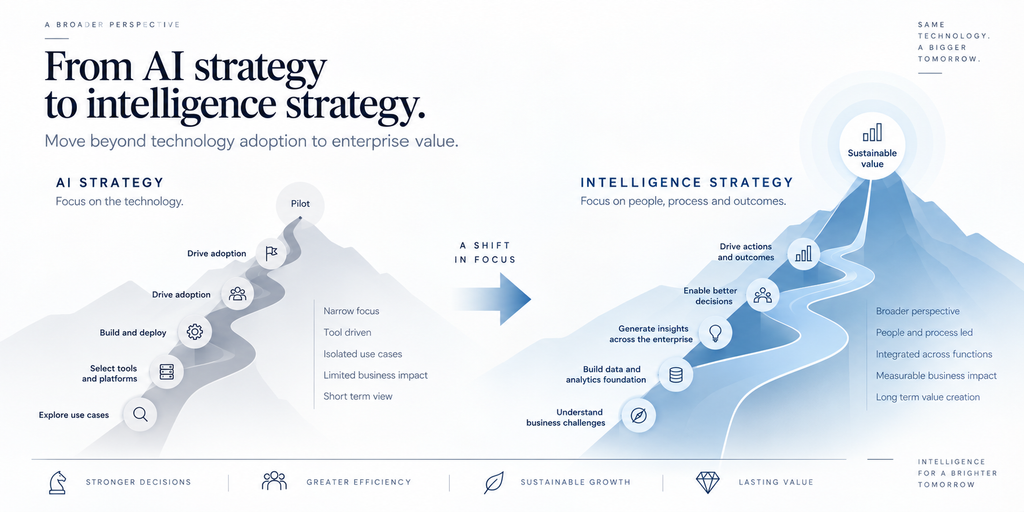
From an AI Strategy to an Intelligence Strategy
Perhaps the larger strategic shift is from thinking about an AI strategy to thinking about an intelligence strategy.
An AI strategy typically asks questions about platforms, models, use cases, capabilities, governance and adoption.
An intelligence strategy starts somewhere else.
It begins with the organization’s most consequential decisions and works backwards.
- What information is required?
- How should that information be interpreted?
- What analytical capabilities are necessary?
- What decisions need to be made?
- Who owns those decisions?
- What actions should follow?
- How should the organization learn from the resulting outcomes?
Within this system, AI can play an increasingly important role.
It can help employees interact with complex information, identify patterns, accelerate analysis, generate scenarios, support recommendations and automate portions of decision workflows.
But the value comes from its position within the system, not from its presence alone.
The strategic shift
| AI-centric organization | Intelligence-centric organization |
|---|---|
| Starts with AI capabilities | Starts with business decisions |
| Builds AI use cases | Builds decision capabilities |
| Measures adoption | Measures outcomes |
| Optimizes technology usage | Optimizes business performance |
| Treats AI as the strategy | Treats AI as an enabler |
| Focuses on what AI can do | Focuses on what the business needs to accomplish |
This is a more durable way of thinking about AI because technologies will continue to change.
Models will become more capable. Costs will change. New platforms will emerge. New applications will become possible.
But the fundamental business questions will remain.
Which decisions matter?
What makes those decisions difficult?
What intelligence is required?
What action should follow?
And did that action improve the outcome?
The Organizations That Win May Not Be the Ones With the Most AI
There is a natural assumption that organizations with the largest AI investments will eventually emerge as the winners.
That may not be true.
The long-term advantage is more likely to belong to organizations that can repeatedly turn data and intelligence into better decisions and better actions.
Such organizations will still invest heavily in AI. But their investments will be connected to a broader architecture involving data, analytics, processes, domain expertise, governance and human judgement.
They will also be more selective.
They will not ask whether something can be automated simply because it can be automated. They will ask whether automation improves the outcome.
They will not deploy AI because a competitor has deployed it. They will ask where the technology creates a meaningful advantage.
Most importantly, they will understand that intelligence has value only when it changes what the organization does.
That may ultimately be the most important lesson from the current AI investment cycle.
The objective is not to become an AI-enabled organization. The objective is to become a more intelligent organization—and use AI wherever it genuinely improves the way the business makes decisions and creates value.
Leave a Reply