



The analytics industry has become obsessed with dashboards, reports and models, while neglecting the real objective of improving decisions, driving measurable business outcomes and creating tangible economic value.
Over the last decade, the analytics industry has experienced explosive growth.
Organizations have invested heavily in business intelligence platforms, data engineering ecosystems, cloud warehouses, visualization tools and advanced analytics capabilities. Entire functions have been built around dashboards, reporting automation and data democratization.
On the surface, this appears to be progress. Companies today have more data than ever before. Leadership teams can access real-time metrics from mobile devices. Business reviews are filled with charts, trends and performance indicators. Every enterprise claims to be “data-driven.”
Yet beneath all this sophistication lies an uncomfortable reality.
Many organizations are producing enormous volumes of analytics outputs while struggling to improve the quality of their actual decisions.
The industry has become obsessed with outputs:
- dashboards created,
- reports automated,
- models deployed,
- pipelines built,
- KPIs tracked.
But far less attention is given to the harder and more important questions:
- Which decisions improved?
- Which costs reduced permanently?
- Which operational risks were mitigated?
- Which business behaviors changed?
- Which strategic actions became faster or smarter?
This is where the analytics industry faces its biggest philosophical problem. It has become exceptionally good at producing information artifacts, but far less effective at ensuring those artifacts translate into business impact.
The Rise of the Output Economy
The modern analytics function was built around visibility. Organizations wanted transparency into operations, finance, sales, supply chains and customer behavior. As technology matured, dashboards became easier to build and reporting became easier to automate.
Eventually, outputs themselves became the benchmark of success.
Analytics teams began showcasing:
- number of dashboards delivered,
- number of users onboarded,
- number of automated reports,
- number of machine learning use cases,
- number of data sources integrated.
These metrics became performance indicators because they were visible, measurable and easy to communicate to leadership.
After all, it is simple to demonstrate a dashboard in a steering committee meeting. It is far more difficult to prove that the dashboard improved pricing decisions, reduced working capital or prevented a risk event.
As a result, the industry slowly drifted toward measuring activity instead of measuring economic value.
This shift may seem subtle, but it fundamentally changed the purpose of analytics inside many organizations.
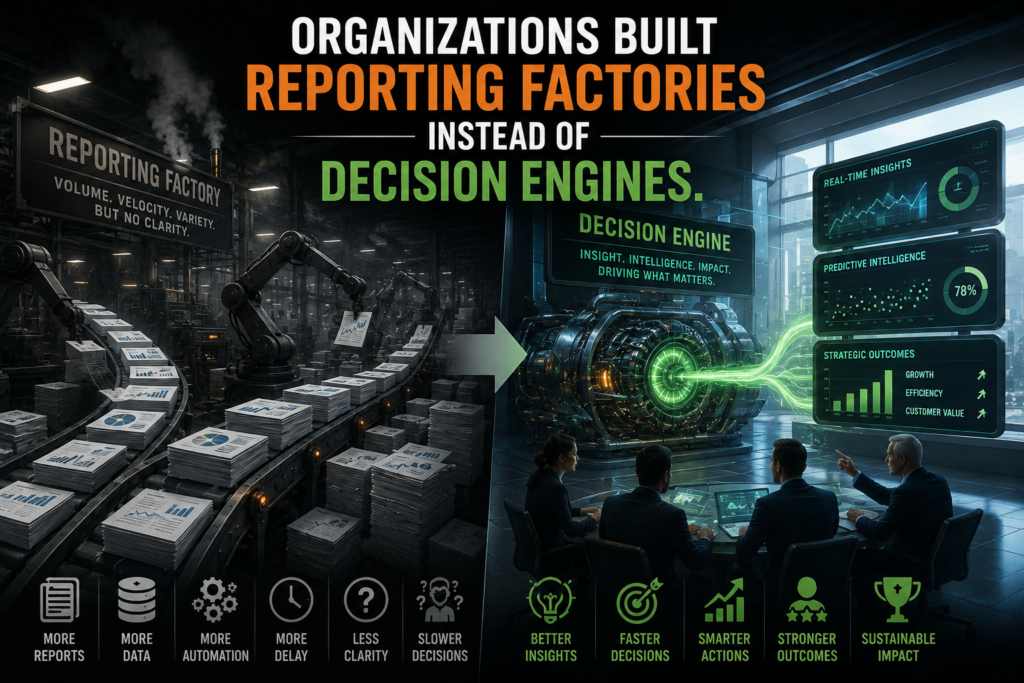
Instead of becoming engines of decision intelligence, analytics teams gradually evolved into production factories for reports and visualizations.
Dashboards Everywhere, Decisions Nowhere
Many organizations today suffer from what can only be described as dashboard inflation.
Every department has its own reporting layer. Sales has dashboards. Finance has dashboards. Procurement has dashboards. Operations has dashboards. Leadership teams often receive dozens of reports every week.
Ironically, the increase in visibility has not necessarily improved clarity.
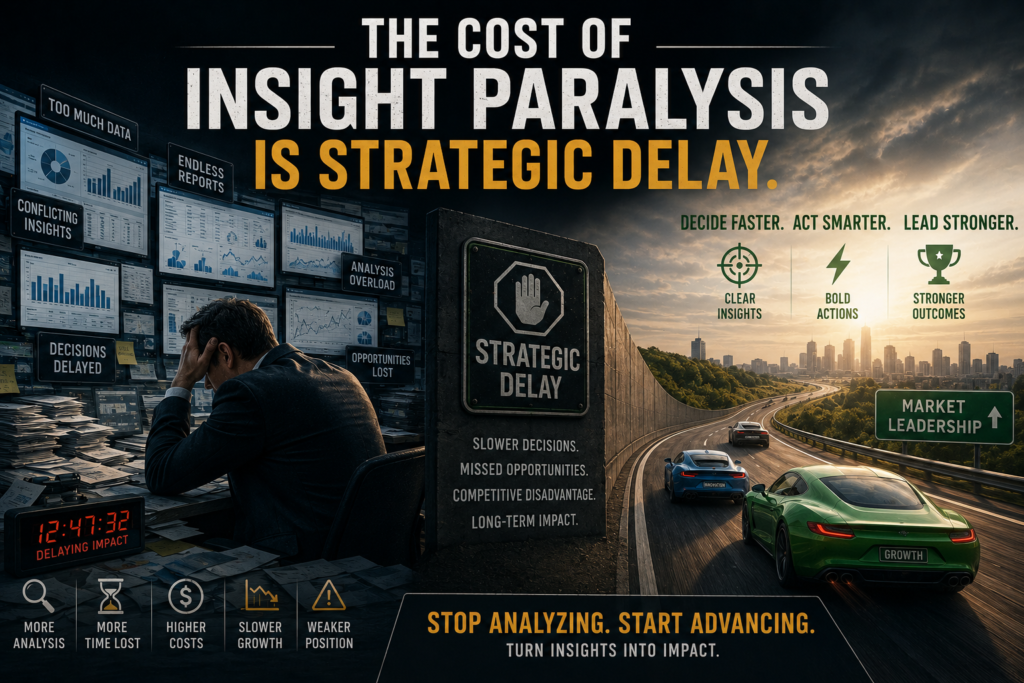
In many cases, organizations are overwhelmed by metrics but under-equipped for prioritization. Teams spend more time reviewing performance than improving it. Meetings revolve around explaining numbers rather than deciding actions.
This is one of the biggest contradictions in modern analytics.
Companies have more information available than ever before, yet decision-making quality often remains inconsistent.
The assumption that “more data automatically creates better decisions” is fundamentally flawed. Information availability and decision quality are not the same thing.
A company can be technologically advanced, deeply instrumented and highly visualized while still making poor operational or strategic decisions.
Because decision-making is not just a data problem. It is also a behavioral, organizational, and accountability problem.
Why the Industry Drifted in This Direction
Part of the issue lies in how analytics functions are structurally positioned.
Most analytics teams do not own decisions. They produce analysis while business teams own execution. The commercial outcome is often disconnected from the analytical output itself.
This creates a dangerous loophole.
If an analytics team builds a forecasting model that nobody operationalizes, the model can still be showcased as a success. If a dashboard is launched but business users rarely act upon it, the project may still be reported as completed.
The industry unintentionally created an environment where outputs could be celebrated without validating real-world impact.
Consulting culture amplified this further. Large transformation programs frequently measured progress through deliverables:
- reports generated,
- systems implemented,
- workflows automated,
- data lakes created.
These deliverables were tangible and contractually measurable. Outcomes, on the other hand, were often long-term, cross-functional and harder to attribute directly.
Even leadership teams contributed to this problem. Executives frequently ask:
- How many dashboards went live?
- How much reporting was automated?
- How many use cases were deployed?
Far fewer ask:
- Which decisions materially improved?
- Which cost structures changed sustainably?
- Which risks became less likely?
- Which business bottlenecks disappeared?
Organizations naturally optimize for the metrics they are rewarded for. If visibility of activity becomes the success criterion, then activity itself becomes the objective.
The Hidden Cost of Output Obsession
The consequences of this mindset are becoming increasingly visible.
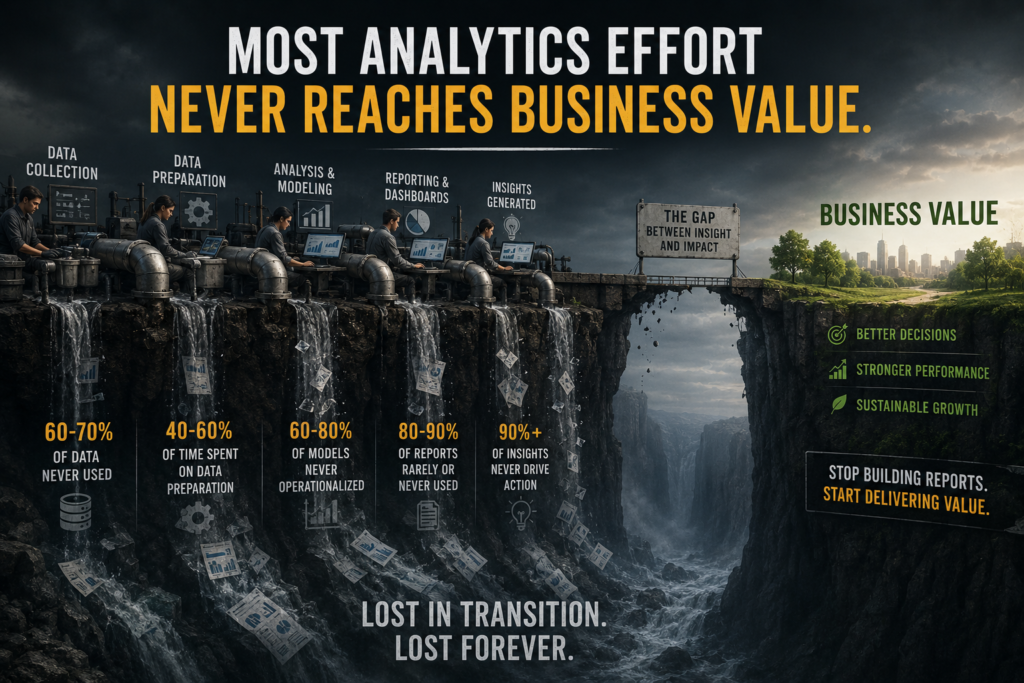
One major side effect is analytics fatigue business users are overloaded with reports, alerts and dashboards. Over time, people stop engaging deeply with the information because too much of it lacks operational relevance.
Another consequence is decision paralysis. When organizations track hundreds of KPIs simultaneously, teams struggle to identify which variables truly matter. Excessive reporting often creates noise instead of clarity.
There is also the growing problem of “model graveyards.” Many companies invest heavily in predictive analytics initiatives that never become embedded into day-to-day operations. Models are built, demonstrated, and celebrated internally, but they fail to influence actual workflows.
Perhaps the most dangerous side effect is the illusion of maturity.
Organizations begin believing they are analytically advanced simply because they possess sophisticated tooling and visualization layers. However, analytical maturity should not be measured by how much data a company can see. It should be measured by how effectively the company acts on that information.
That distinction is critical.
The Difference Between Outputs and Outcomes
One of the biggest misconceptions in analytics is the belief that outputs automatically generate value.
They do not.
- A dashboard is an output. Faster pricing decisions are an outcome.
- A predictive model is an output. Lower inventory losses are an outcome.
- A risk monitoring system is an output. Fraud prevention is an outcome.
The industry often stops at the output stage because outputs are easier to measure and easier to celebrate.
Outcomes demand accountability.
To truly measure analytics effectiveness, organizations need to shift their focus from production metrics to decision metrics.
For example, instead of asking: “How many dashboards were created?”
Companies should ask: “How much faster did management respond to operational deviations?”
Instead of: “How many reports were automated?”
The better question is: “How much manual effort and decision delay were eliminated?”
This requires analytics teams to think beyond reporting and move closer to business execution.
The Need for a Decision-Centric Analytics Culture
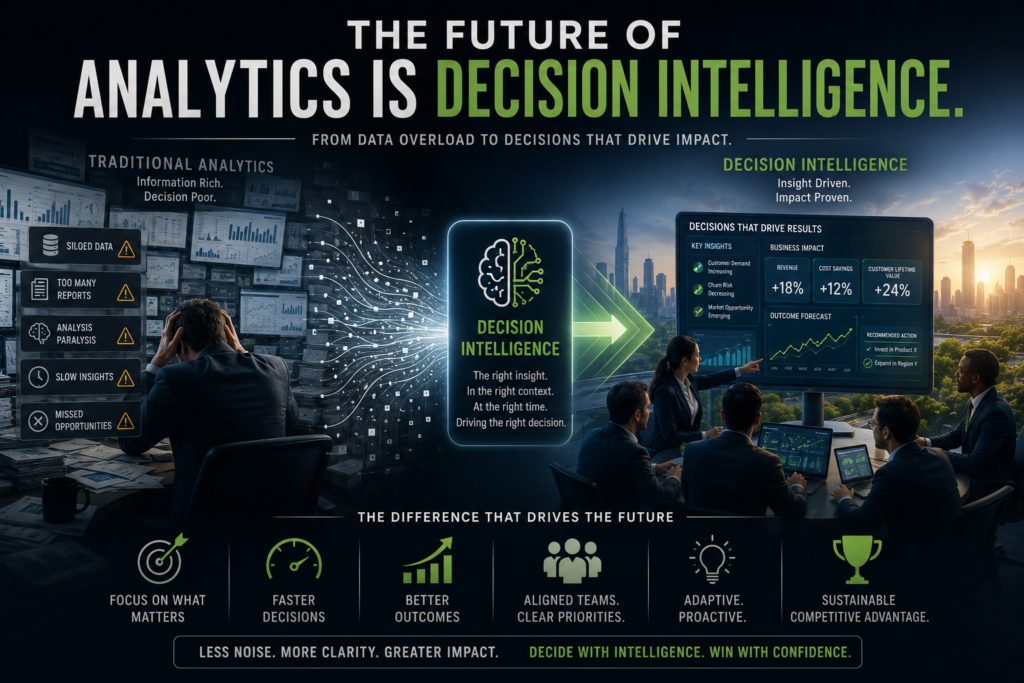
The future of analytics will belong to organizations that focus less on information delivery and more on decision enablement.
This requires a fundamental mindset shift.
Analytics should not begin with dashboards. It should begin with decisions.
Before building any analytical solution, organizations should first define:
- Which decision is being improved?
- Who will act on the insight?
- What behavior should change?
- What economic impact is expected?
- How will success be measured?
These questions force analytics initiatives to remain connected to operational reality.
High-performing analytics organizations already operate differently. They embed analytics into workflows instead of isolating it inside reporting systems. They measure adoption, intervention effectiveness and business outcomes rather than just technical completion.
Most importantly, they recognize that analytics is not merely a technology capability.
It is a decision capability.
That distinction changes everything.
Moving Beyond the Dashboard Era
The analytics industry is entering a phase where output generation is becoming increasingly commoditized. Visualization tools are easier to use than ever before. Reporting automation is rapidly expanding. Data infrastructure is becoming standardized.
As these capabilities become common, competitive advantage will no longer come from producing more outputs.
It will come from improving decision quality faster than competitors.
Organizations that continue measuring success through dashboards and reporting volumes may appear analytically mature while remaining strategically weak.
The companies that will truly differentiate themselves are those that connect analytics directly to execution, accountability and measurable business value.
Because in the end, the purpose of analytics is not to produce charts.
It is to help organizations make better decisions.
And until the industry starts measuring that more seriously, it will continue mistaking visibility for value.
Leave a Reply