



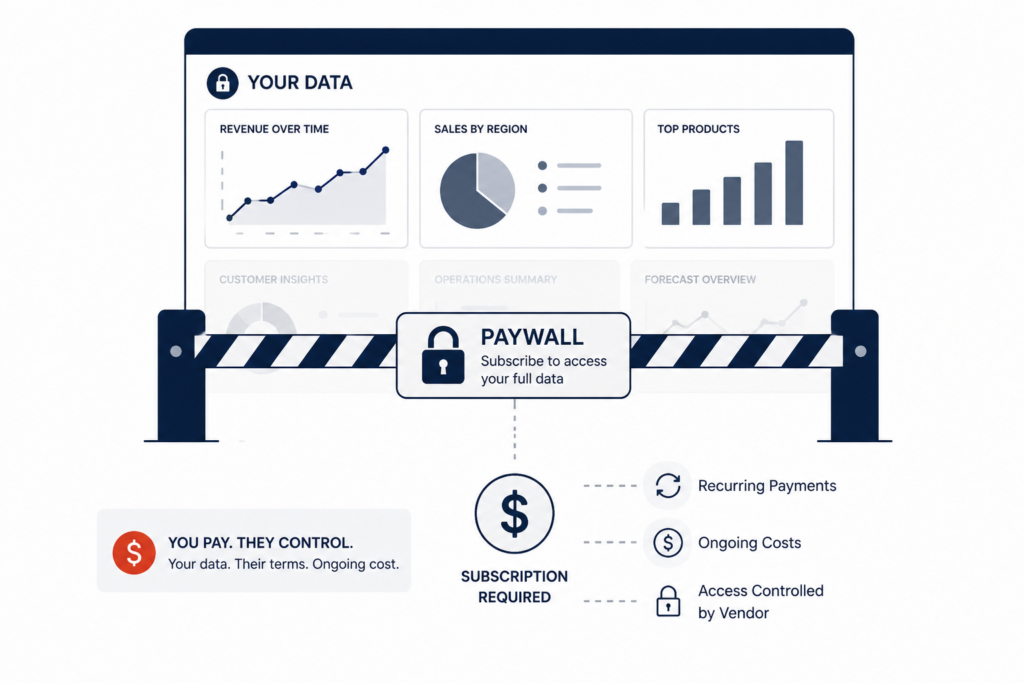
You’re paying to access your own data. Vendor systems control access, logic, and speed. Build an independent data layer to regain control, flexibility, and decision agility.
I’ve experienced this play out across companies that are otherwise well-run.
A team wants a slightly different view of their numbers. Nothing complex. Maybe a new margin view, maybe a cross-functional analysis. The data already exists. It’s inside the system. But getting to it takes time. Someone needs access. A request is raised. A vendor gets involved. Sometimes there’s a cost. Almost always, there’s a delay.
What nobody questions is the structure behind this.
The company generated the data. The company paid for the system. And yet, every time it wants to use that data differently, it has to go back and ask.
That’s where the discomfort should be.
Where Your Data Actually Lives
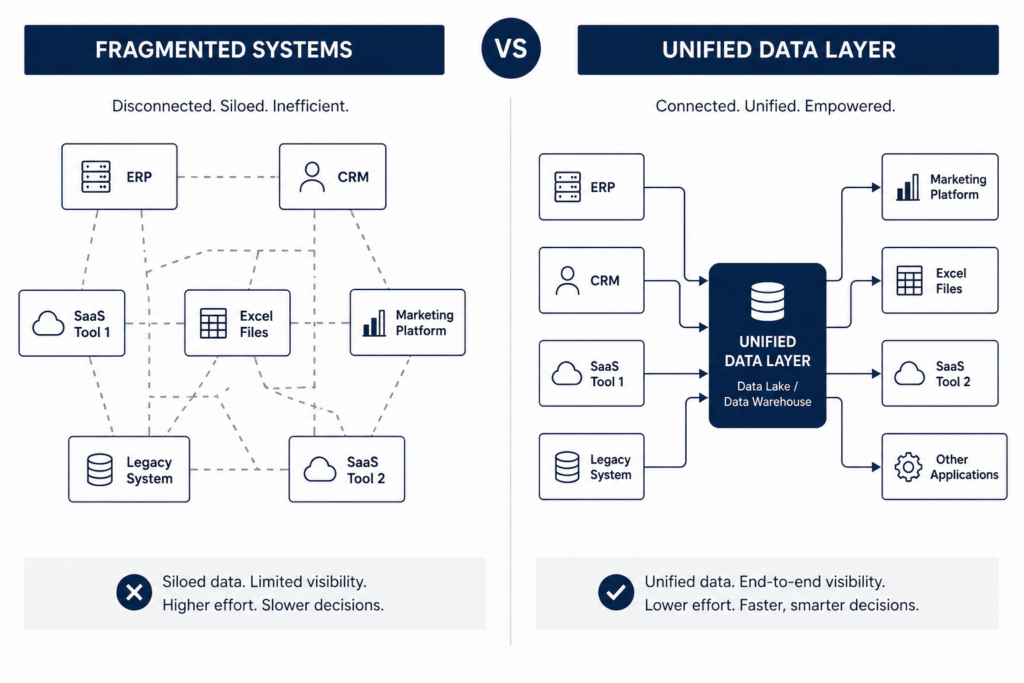
In most enterprises, data is scattered across systems that are individually strong but collectively restrictive.
ERP platforms like SAP S/4HANA run financials and operations. CRM systems like Salesforce capture customer activity. Reporting sits on top through tools like Power BI or Tableau.
Each system is optimized for a purpose. None of them is designed to give you full, flexible control over your data across the business.
That gap is where the friction begins.
The Real Problem Is Not Storage. It’s Control
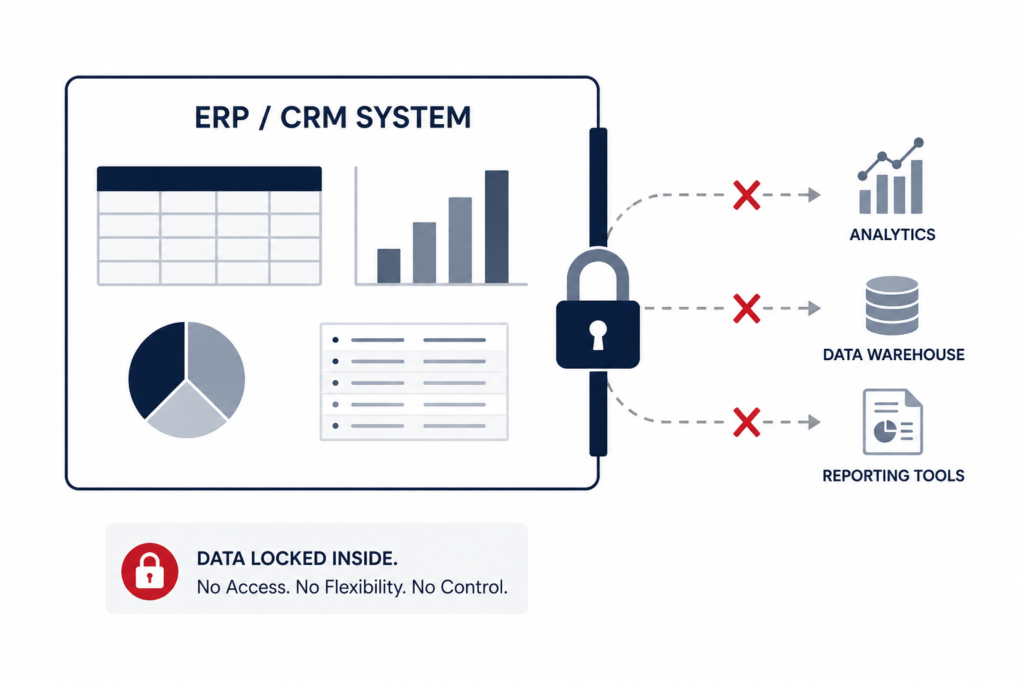
Most conversations start with where data is stored. That’s not where the issue lies.
The issue is control.
Over time, three constraints quietly build up:
- Access gets restricted — through licenses, permissions, API limits
- Logic gets embedded — KPIs and calculations live inside systems
- Changes become dependent — every new requirement needs intervention
Individually, these are manageable. Together, they define the limits of how you can use your own data.
And those limits are often not set by you.
The Question I Keep Getting
Whenever we talk to clients about building an independent data layer, the first response is almost always:
- “We already have a system.”
- “We already get reports.”
- “Why do we need a data lake?”
It’s a valid question.
If your current setup is giving you standard reports, it feels like everything is working.
But the problem doesn’t show up in standard reporting.
It shows up the moment the business asks something slightly outside the system’s design.
That’s when things slow down.
What Looks Fine – Until It Doesn’t
On the surface, most organizations have what they need:
- Systems that store and process data
- Dashboards that show predefined views
- Some level of reporting flexibility
And for routine requirements, that works.
But the moment you step outside predefined views, you start noticing the friction. Access isn’t as open as it seemed. Logic isn’t as transparent as expected. Flexibility comes with effort.
That’s when the real limitation shows up.
What Actually Happens on the Ground
This is where things get real.
I’ve seen finance teams export data into Excel – not by choice, but out of necessity. It’s the only place where they can work freely.
I’ve seen teams maintain parallel datasets because getting a unified view from the system is too slow.
I’ve seen simple changes in reporting logic take longer than the decisions they were meant to support.
At some point, people stop relying on the system. They start working around it.
And once that happens, you’re no longer dealing with a tool issue.
You’re dealing with a structural constraint.
The Cost You Don’t See Immediately
This isn’t just about paying for licenses or reports.
The bigger cost shows up in how the organization starts behaving.
- Decisions take longer because data isn’t readily usable
- Teams stop asking deeper questions because it’s too cumbersome
- Dependencies increase with every new requirement
Over time, this compounds quietly.
And gradually, the system that was meant to enable decisions starts slowing them down.
This is usually the point where the “why do we need a data lake?” question starts to shift.
Because the answer is not about adding another tool.
It’s about removing dependency.
A data lake or any independent data layer is not there to replace your ERP or CRM. It’s there to ensure those systems don’t control how you use your data.
What an Independent Data Layer Actually Does
At its core, it’s a simple shift.
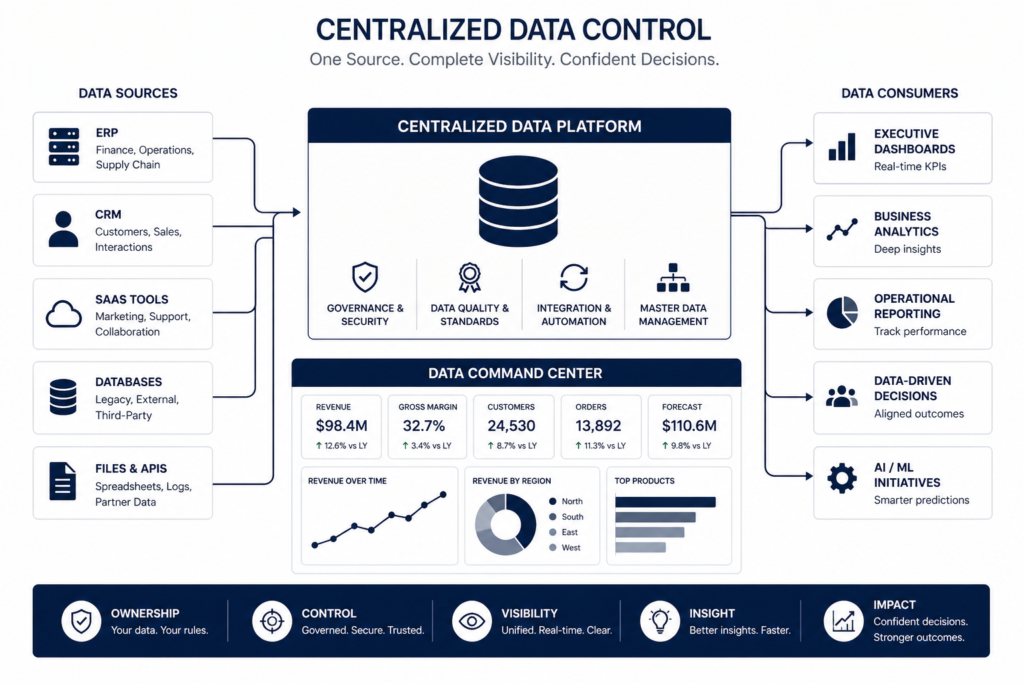
Instead of letting systems be both data sources and gatekeepers, you separate the two.
You pull data out and bring it into a layer you control. From there:
- You define your own logic
- You combine data across systems freely
- You run analytics without restrictions
Your systems continue to operate. But they stop being the only place where data can be understood.
They become inputs.
Once this layer exists, something changes almost immediately.
You stop asking, “Can the system give me this?”
You start asking, “What do we want to know?”
That shift improves:
- Speed — faster turnaround on analysis
- Control — no dependency on vendor cycles
- Clarity — single version of truth
And over time, it gives you something even more important—leverage.
Start Small, But Start
This doesn’t require a large-scale transformation.
In most cases, it starts small:
- Pick a few critical datasets
- Extract them regularly
- Store them independently
- Rebuild a handful of key metrics
Even this limited step creates a noticeable difference.
Because once teams experience unrestricted access to data, expectations change.
Closing Thought
When someone asks me, “why do we need a data lake?”, I don’t answer it with architecture diagrams.
I ask a simpler question.
Can you use your data freely without licenses, delays or dependencies?
If the answer is no, then the problem isn’t whether you need a data lake.
The problem is that your systems are deciding how fast you can think.
Leave a Reply