



Application-level dashboards provide operational visibility, but sustainable competitive advantage requires integrated, enterprise-wide analytics and a unified view.
Over the past decade, enterprise applications have evolved significantly. Modern ERP platforms, CRM systems, HR solutions, supply chain applications, and finance systems increasingly come equipped with built-in reporting and visualization capabilities.
Vendors now position analytics as an integral component of their offerings, promising real-time visibility and improved decision-making.
As a result, many organizations are beginning to question whether they need separate investments in data platforms, business intelligence, or enterprise analytics capabilities. After all, if every application already provides dashboards and reports, what additional value does an enterprise-wide analytics strategy deliver?
While this line of thinking appears logical on the surface, it overlooks a fundamental distinction between operational reporting and enterprise intelligence. Organizations that equate embedded analytics with enterprise analytics often discover that despite possessing numerous dashboards, they continue to struggle with fragmented information, inconsistent metrics, and limited visibility across business functions.
The challenge is not the absence of data. It is the inability to connect the data that already exists.
The Rise of Embedded Analytics
Application vendors have made significant investments in analytical capabilities. A customer relationship management system provides sales pipeline reports and conversion metrics. Human resource applications offer insights into attrition, attendance, and workforce demographics. ERP platforms provide visibility into procurement, inventory, and production activities. Financial systems enable reporting on revenues, costs, and profitability.
These capabilities undoubtedly add value. Operational teams can monitor day-to-day activities and identify issues within their respective domains. Managers have immediate access to key indicators relevant to their functions, enabling faster responses and improved operational control.
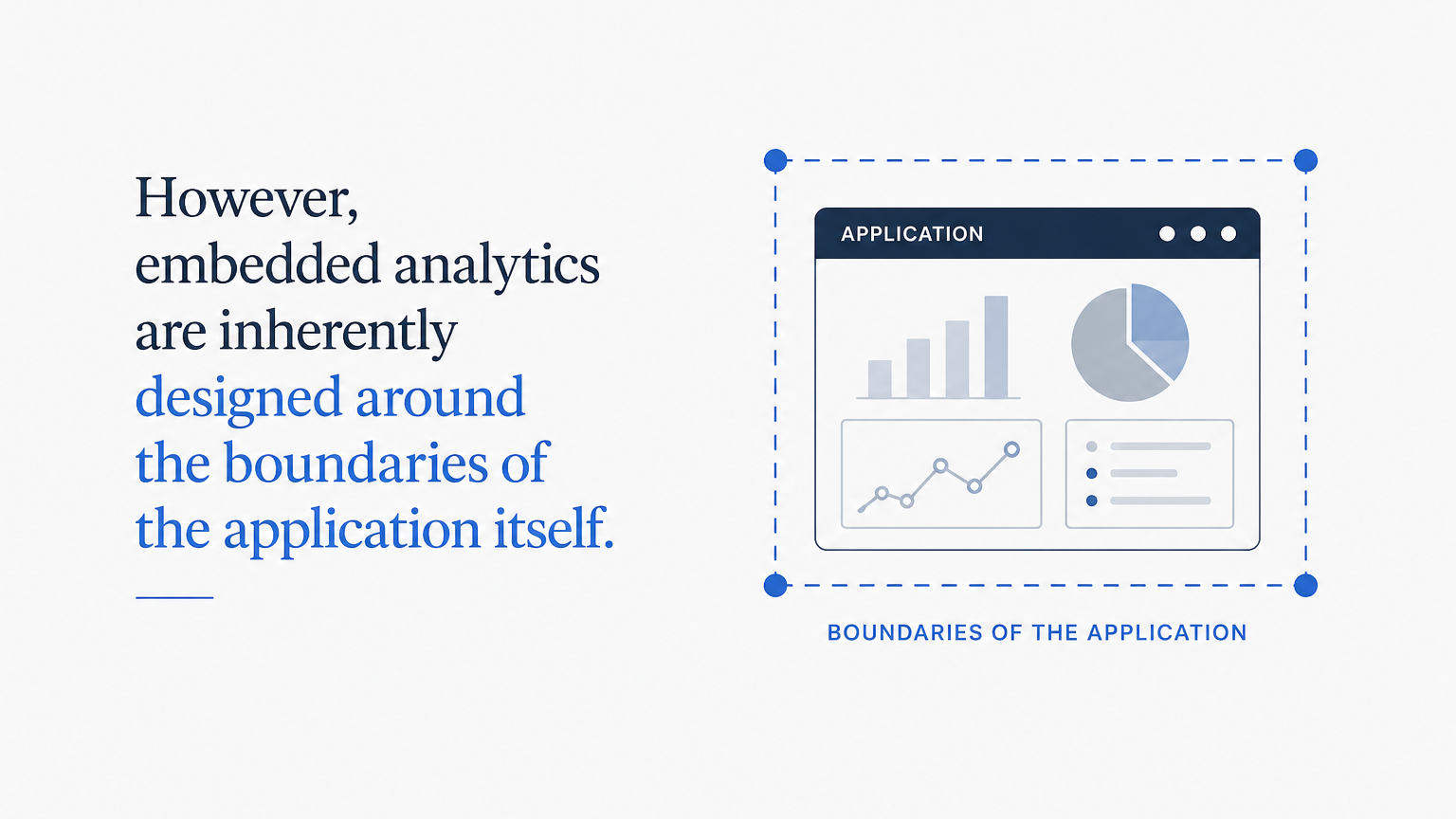
However, embedded analytics are inherently designed around the boundaries of the application itself. They answer questions related to the process that the system manages.
- Sales applications answer questions about opportunities and conversions.
- HR systems answer questions about employee movements and workforce metrics.
- Finance systems answer questions about revenues, expenses, and cash positions.
Yet businesses do not operate in isolated functional silos. Strategic decisions seldom originate from a single department. They require understanding the interactions between multiple functions, processes, and external factors.
This is where the limitations of application-centric analytics become apparent.
The Problem with Functional Silos
Consider a manufacturing organization experiencing declining revenues.
A sales dashboard may reveal that revenue has fallen by 12 percent over the previous quarter. While this information highlights the existence of a problem, it does not explain the underlying causes.
- Was revenue affected because demand weakened?
- Did inventory shortages result in missed orders?
- Were production bottlenecks responsible for delayed deliveries?
- Did customer complaints lead to increased cancellations?
- Was the issue concentrated within a particular geography or customer segment?
None of these questions can be answered from the sales application alone.
The root causes may reside across multiple systems:
- CRM systems containing customer and order information.
- ERP systems managing production and inventory.
- Supply chain platforms tracking procurement and logistics.
- Service management applications recording customer complaints.
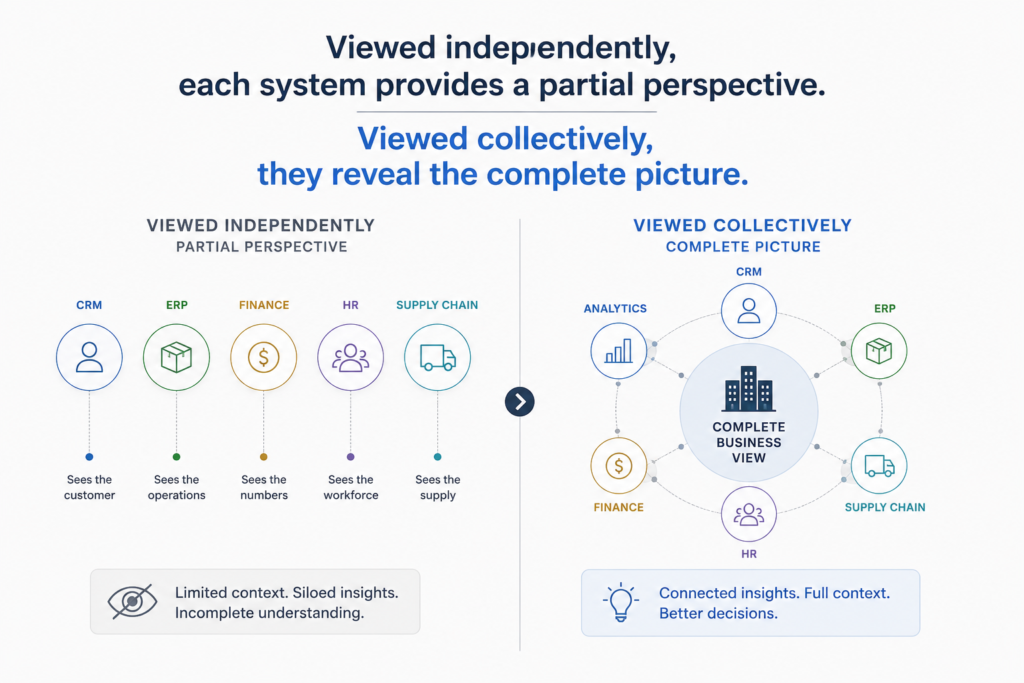
Viewed independently, each system provides a partial perspective. Viewed collectively, they reveal the complete picture.
Organizations often discover that despite having dozens of dashboards, they still spend significant amounts of time conducting manual investigations and reconciling information from different sources.
In many cases, the challenge is not generating reports. It is connecting insights.
Operational Visibility Is Not the Same as Enterprise Visibility
Functional reporting serves operational needs. Enterprise leadership requires a broader perspective.
Chief executives rarely ask questions confined to a single application.
Instead, they seek answers to questions such as:
- Which customer segments generate the highest profitability?
- How does employee productivity influence operational performance?
- Which products are creating margin erosion?
- What factors contribute to customer churn?
- Which regions deliver sustainable growth?
- How do inventory levels affect working capital and service performance?
Answering these questions requires integrating information across finance, sales, operations, supply chain, customer service, and human resources.
For example, customer profitability cannot be determined solely from sales revenues. A customer generating high revenues may simultaneously require extensive support, frequent returns, and higher logistics costs.
Understanding true profitability demands combining information from:
- Sales systems.
- Finance platforms.
- Customer service applications.
- Logistics systems.
- Accounts receivable processes.
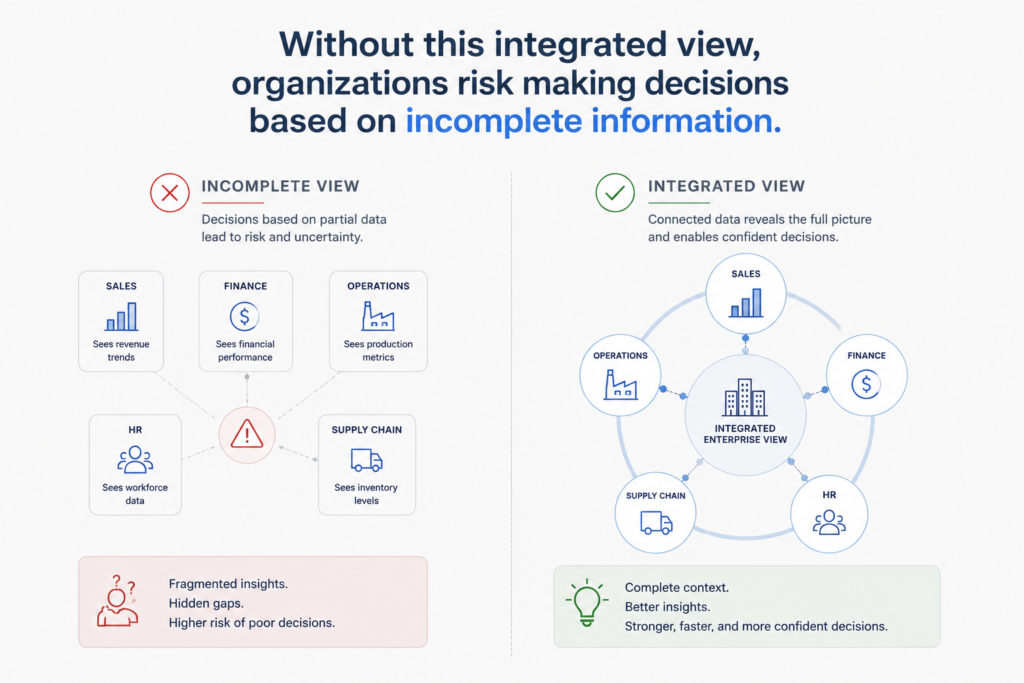
Without this integrated view, organizations risk making decisions based on incomplete information.
Generic Analytics Cannot Capture Unique Business Realities
Enterprise software vendors face an inherent challenge. Their products are designed to serve thousands of customers across industries and geographies. Consequently, embedded dashboards are necessarily generic.
Two pharmaceutical companies may use the same ERP system. However, their business priorities may differ substantially.
One organization may focus on improving manufacturing yields and batch efficiencies. Another may prioritize regulatory compliance and service levels.
Similarly, two retailers using identical CRM platforms may pursue entirely different strategies. One may emphasize customer lifetime value, while another may prioritize market share expansion.
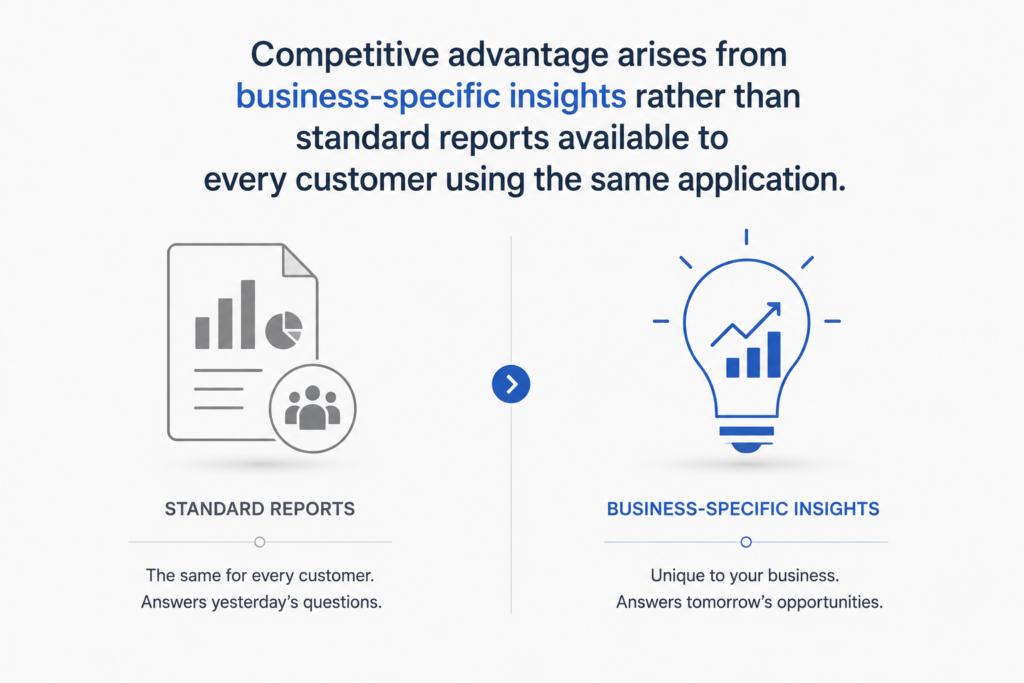
Competitive advantage arises from business-specific insights rather than standard reports available to every customer using the same application.
Organizations increasingly recognize that differentiation does not come from owning software. It comes from understanding their business better than competitors.
Standard dashboards, while useful, rarely provide this level of differentiation.
Customization Often Becomes Expensive and Restrictive
Many organizations initially attempt to address analytical requirements through application-level customizations.
- Additional reports are requested.
- New metrics are defined.
- Dashboards are modified.
Over time, several challenges emerge. Every enhancement requires vendor support or specialized technical resources. Report development cycles become lengthy. Costs increase with each customization. Future application upgrades become more complex.
Business users find themselves constrained by the reporting capabilities of individual applications.
Eventually, organizations realize that analytics should not be dictated by the architecture of software products. Rather, analytical capabilities should evolve according to business priorities.
When reporting becomes tightly coupled with transactional systems, agility often suffers.
Multiple Systems Often Create Multiple Versions of Truth
One of the most common challenges faced by organizations is the existence of conflicting numbers.
Sales figures reported by the CRM system differ from those reported by finance.
Customer counts vary between marketing platforms and ERP systems.
Inventory balances do not align across warehouse and planning applications.
As a result, meetings frequently begin with discussions about which numbers are correct rather than what actions need to be taken.
Decision-making slows. Confidence in analytics deteriorates. Business users revert to spreadsheets and manual reconciliations.
Ironically, organizations possessing abundant data often struggle with a lack of trust in that data.
Without a common foundation, every department develops its own interpretation of performance.
The consequence is not merely inefficiency. It is organizational misalignment.
Why Enterprise Analytics Requires a Different Architecture
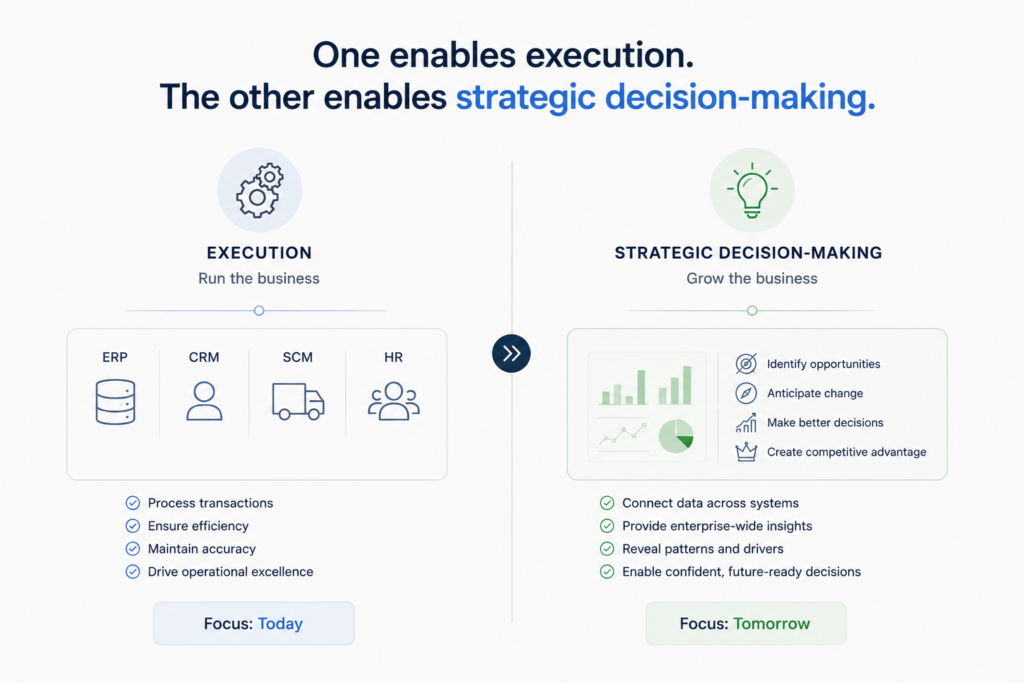
Applications are systems of execution.
Their primary purpose is to support business processes and transactions.
Enterprise analytics, however, serves a different objective. Its purpose is to provide a unified understanding of business performance.
This requires integrating information from multiple sources into a common data foundation.
Such an approach enables organizations to establish:
- Standardized metrics.
- Common definitions.
- Cross-functional visibility.
- Historical analysis.
- Enterprise-wide performance measurement.
Instead of viewing data through isolated applications, organizations gain a consolidated perspective across the business.
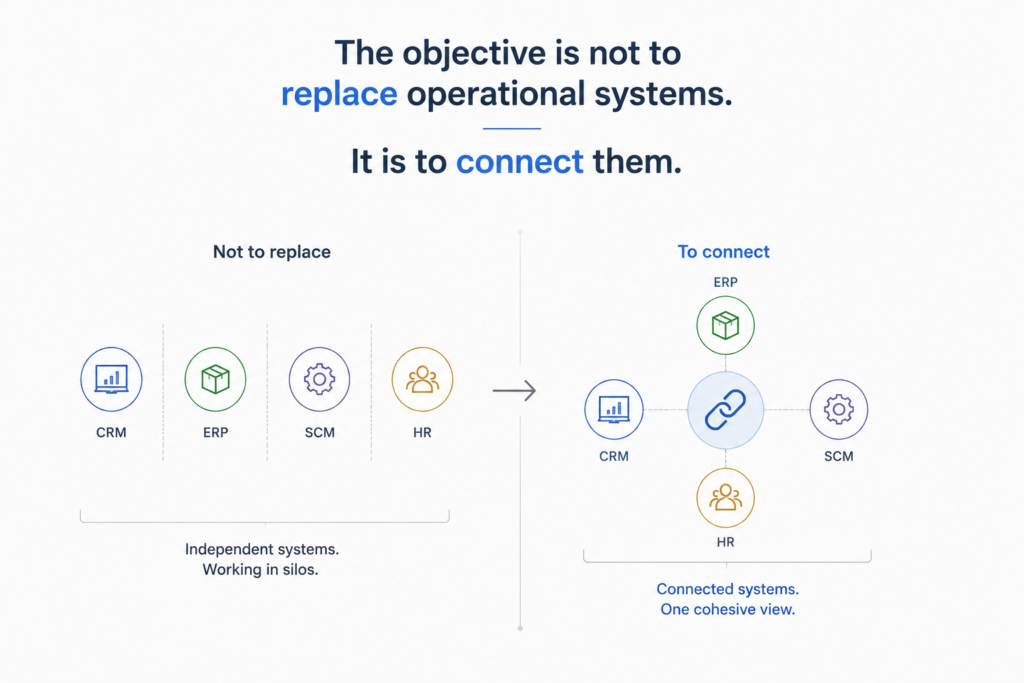
The objective is not to replace operational systems. It is to connect them.
The Power of Cross-Functional Insights
The greatest value of enterprise analytics lies in revealing relationships that individual systems cannot expose.
Customer Profitability
High revenue does not necessarily imply high profitability.
By integrating sales, logistics, support costs, discounts, and collections data, organizations can identify customers who generate sustainable value and those who consume disproportionate resources.
Supply Chain Performance
Inventory shortages are often symptoms rather than root causes.
Combining procurement, manufacturing, logistics, and demand data enables organizations to identify bottlenecks and improve service levels.
Workforce Productivity
Human resource metrics become significantly more meaningful when correlated with operational performance.
Organizations can understand how absenteeism, attrition, or skill shortages influence production efficiency and customer satisfaction.
Revenue Leakage
Lost sales opportunities may originate from delayed production, inadequate inventory, pricing issues, or service failures.
Only an integrated view can reveal the complete chain of events contributing to revenue loss.
These insights are difficult, if not impossible, to derive from isolated dashboards.
Building the Enterprise Command Center
Increasingly, organizations are moving toward a consolidated performance management approach.
Rather than navigating multiple applications and reports, leadership teams seek a single view of enterprise performance.
Such command centers bring together metrics across:
- Financial performance.
- Sales and marketing.
- Operations and manufacturing.
- Supply chain.
- Customer experience.
- Human resources.
- Risk and compliance.
This approach provides a common language for decision-making.
Departments no longer optimize their own objectives at the expense of enterprise outcomes.
Instead, decisions are aligned around broader business goals.
Embedded Analytics and Enterprise Analytics Are Complementary
The debate should not be framed as one versus the other.
Embedded analytics continue to play an important role. Operational users require immediate access to information within their applications. Functional dashboards improve efficiency and support day-to-day execution.
However, enterprise analytics addresses a fundamentally different need.
Embedded analytics answer: “What is happening inside my function?”
Enterprise analytics answers: “What is happening across my business?”
Both capabilities are essential.
One enables execution. The other enables strategic decision-making.
Looking Ahead
Organizations are investing heavily in digital transformation and enterprise applications. Yet many continue to struggle with fragmented information and inconsistent performance measurement.
The issue is rarely a lack of technology. Most enterprises already possess abundant data and numerous reporting tools. The challenge lies in connecting these assets into a coherent view of the business.
Applications remain indispensable systems of record. But competitive advantage increasingly depends on transforming isolated information into enterprise-wide insight.
Ultimately, organizations do not create value by having more dashboards. They create value by enabling better decisions.
And better decisions require a view of the business that no individual application can provide.
Leave a Reply